


Navigating the National Disability Insurance Scheme (NDIS) can feel like learning a new language, especially when you’re trying to understand how your funding works, what you can spend it on, and how to make sure your plan actually supports the life you want.
You’re not alone if it feels confusing. Many people living with disability, along with their families and support coordinators, say the same thing.
The good news is that once you break it down, NDIS funding becomes much clearer.
This guide covers how NDIS funding works, the three funding types, who they support, real examples, plan flexibility, management options, exclusions, pricing, and how to use your funding with confidence.
Whether you’re new to the NDIS or supporting a loved one, this article is here to walk beside you with clarity, warmth, and respect.
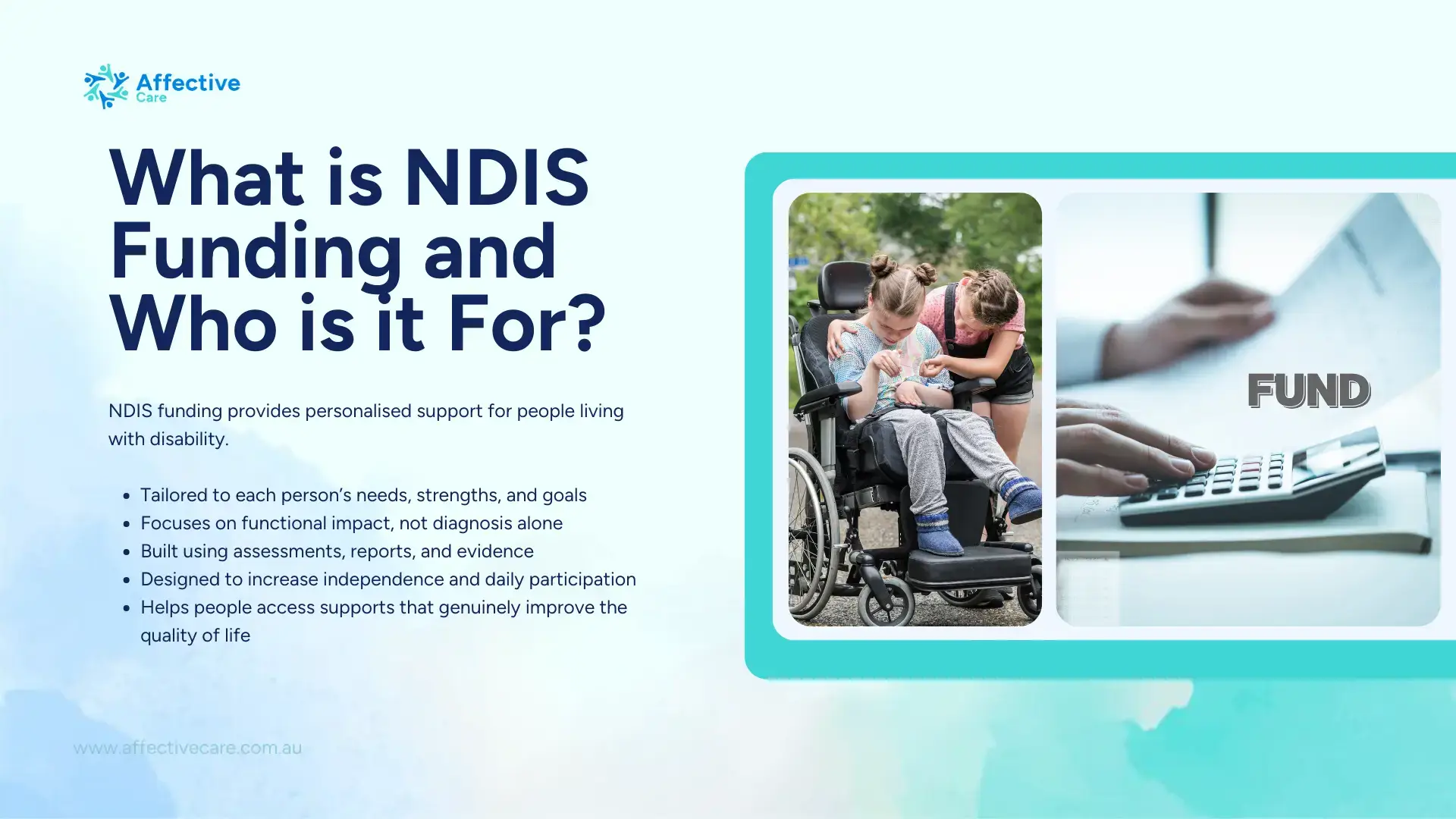
What is NDIS Funding and Who is it For?
NDIS funding is individualised support for people living with disability who meet the scheme’s access requirements.
Rather than giving everyone the same support, the NDIS assesses each person’s goals, functional needs, environment, strengths, and daily challenges to create a plan tailored to them.
NDIS funding is:
- Individual: Tailored to each person
- Goal-based: Built around what you want to achieve
- Evidence-informed: Based on functional assessments and reports
- Needs-based: Not diagnosis-based
- Flexible: Within specific support categories
- Designed to increase independence and participation
Your NDIS plan typically includes a combination of budgets across Core Supports, Capacity Building Supports, and Capital Supports, depending on your needs.
It’s important to note that NDIS funding does not cover everything. Some expenses, such as rent, food, medical treatments, and household bills, are not covered.

The Three Main NDIS Funding Types (Plus Recurring Supports)
The NDIS organises supports into three major funding categories:
- Core Supports: Everyday supports to help you live your daily life
- Capacity Building Supports: Services that help build skills and independence
- Capital Supports: Assistive technology, equipment, and home modifications.
- Recurring Supports: Regular ongoing payments for specific essential supports
Each category has its own purpose, rules, and level of flexibility. Here’s a simple overview before we explore each one in detail.
|
Funding Type |
Purpose |
Examples |
|
Core Supports |
Everyday help |
Personal care, community access, transport |
|
Capacity Building |
Skill development & therapy |
OT, behaviour support, employment skills |
|
Capital Supports |
Higher-cost items |
Wheelchairs, home mods, SDA |
|
Recurring |
Regular ongoing supports |
Consumables, some therapies |
Not every participant receives all three. Your plan will reflect your goals and needs.
Core Supports: Funding for Everyday Life
Core Supports are usually the most flexible part of your plan. They cover daily activities directly related to your disability. Core supports include four categories:
Assistance with Daily Life
Support workers helping with:
- Showering, dressing, and grooming
- Meal preparation
- Medication prompts
- Cleaning and household tasks
- Support during morning and evening routines
- In-home support and safety monitoring
Transport
Funding to help you travel to school, work, the community, or appointments.
Consumables
Every day, disability-related items such as:
- Continence products
- Nutritional supplements (if disability-related)
- Low-cost AT like sensory tools, therapy items, or communication boards
Social and Community Participation
It supports:
- Attend appointments
- Join community activities
- Build social skills
- Access recreation or education
Core Funding Flexibility
Core Supports are the most flexible part of your NDIS plan.
In most cases, you can transfer funds between Core categories such as Daily Living, Transport, Consumables, and Community Participation to adjust your support as your needs change.
This allows you to increase support worker hours, redirect funds to community activities, or cover extra consumables when needed.
However, flexibility doesn’t apply to stated supports, in-kind funding, or supports tied to SIL or high-intensity requirements.
Capacity Building Supports: Growing Skills and Independence
Capacity-building support helps you learn new skills, build independence, and work toward long-term goals.
These categories are less flexible than Core. Funds cannot be moved between categories.
Capacity Building categories include:
- Improved Daily Living (OT, speech therapy, psychology)
- Improved Relationships (Behaviour support)
- Improved Life Choices (Plan management)
- Finding and Keeping a Job (Employment supports)
- Improved Health and Wellbeing (Exercise physiology, allied health)
- Improved Learning (Support to access education)
- Increased Social and Community Participation (Skill-Building)
- Support Coordination
Example: A child may use Capacity Building for weekly speech therapy, plus a behaviour support practitioner who helps with emotional regulation at school and home.
Example (adult): A young person preparing for work might use Capacity Building for job-readiness training, OT for executive functioning, and therapy to build confidence.
Capital Supports: Assistive Technology, Housing, and Home Modifications
Capital Supports are typically the least flexible funding type. They cover items that help you live safely and independently, such as:
Assistive Technology (AT)
- Wheelchairs
- Hoists
- Communication devices
- Specialised seating
- Mobility equipment
Home Modifications
- Ramps
- Bathroom modifications
- Widened doorways
- Safety rails
- Flooring changes
Specialist Disability Accommodation (SDA)
For people with extreme functional impairment or very high support needs, SDA funds the home itself, not the daily support inside it.
Recurring Supports
Some items are funded regularly, such as essential equipment servicing or renewal.
Because Capital involves higher-cost items, the NDIS requires:
- Assessments
- Quotes
- Safety justification
- Detailed evidence

How Flexible is My NDIS Funding?
Understanding how flexible your NDIS funding is can make a big difference in how confidently you use your plan.
Many people find this part confusing at first, because each funding category has different rules.
The good news is that once you break it down, the structure becomes much easier to navigate.
Core Supports: The Most Flexible Part of Your Plan
Core Supports give you the most flexibility to reallocate funding based on your day-to-day needs.
It is designed to adapt to your real life, not lock you into a rigid routine.
What you can do
- Shift funding between most Core categories (Daily Living, Community Participation, Consumables, Transport).
- Adjust the number of hours or types of support as life changes.
- Choose when and how supports are delivered.
Exceptions
- Some supports are stated and must be used exactly as written.
- SIL (Supported Independent Living) is not flexible; it has strict funding rules.
- Certain high-intensity supports may be subject to fixed NDIA pricing or staffing requirements.
Capacity Building: Structured but Still Personalised
Capacity Building helps you grow skills, build independence, and work towards your goals. It offers choice, but not the ability to move between categories.
What you can do
- Choose which provider you want (therapy, support coordination, exercise physiology, etc).
- Decide how often you want sessions, depending on your budget.
- Work with providers to prioritise what matters most for your goals.
Exceptions
- Move money between categories (e.g., therapy funds can’t be used for employment support).
- Transfer funds into Core or Capital.
Capital Supports: No Flexibility, Highly Specific
Capital Supports are for bigger, specialised items that require safety checks, quotes, and professional assessments.
Examples include
- Wheelchairs
- Home modifications
- Assistive technology
- Specialist Disability Accommodation (SDA)
Important
- You must use Capital funding exactly as approved.
- Funds cannot be moved elsewhere.
- Items usually need quotes and reports before approval.
Still Unsure What’s Flexible? You Don’t Have to Guess
NDIS plans can be complex, especially if it’s your first or your needs have changed. If you feel uncertain, you can always talk to your:
- Support coordinator
- Plan manager
- Provider or allied health professional
They can help you understand what’s flexible, what isn’t, and how to make your funding work in the way that supports your goals and wellbeing.
You deserve clarity, and you’re never expected to figure it all out alone.
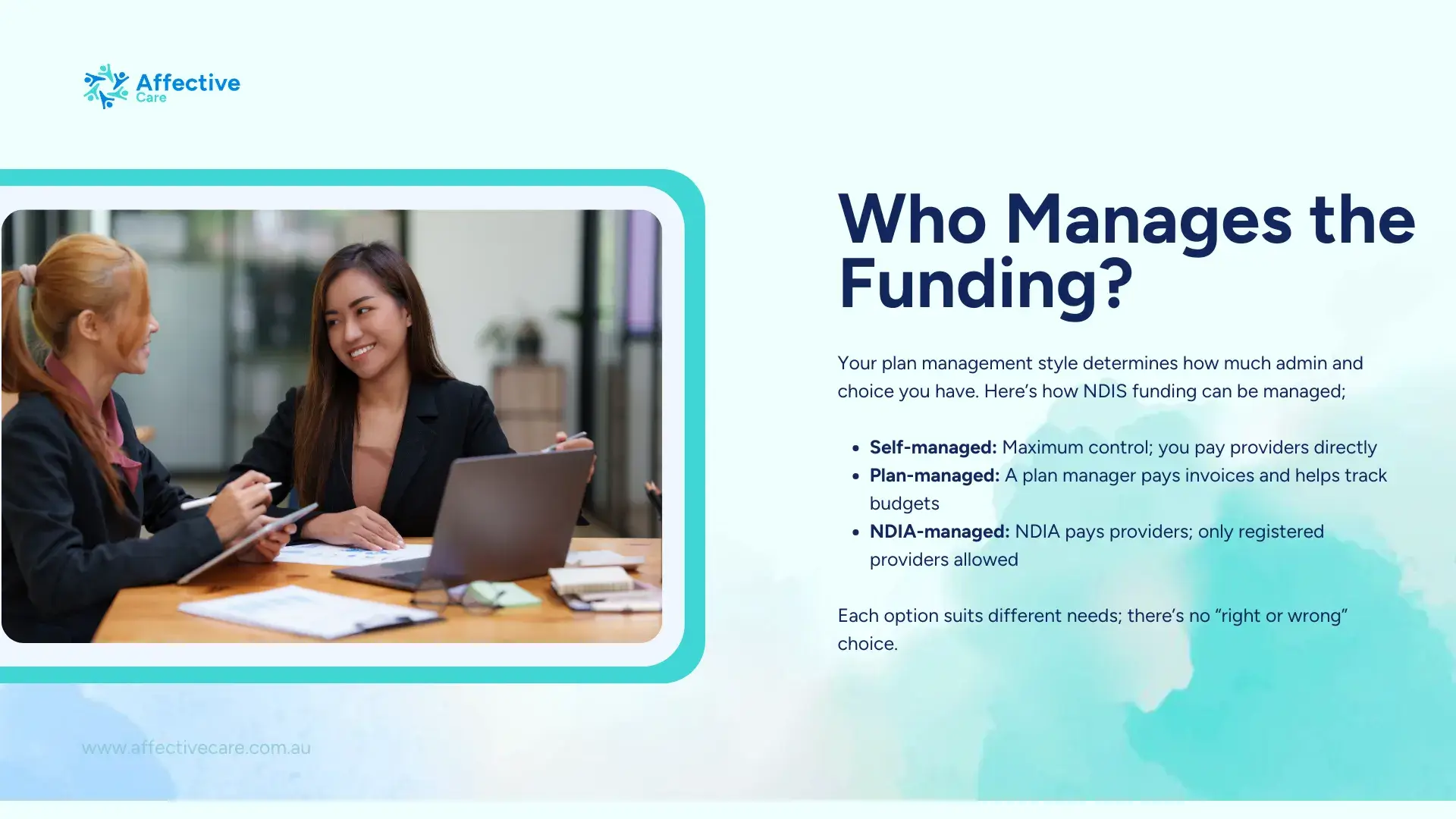
Who Manages the NDIS Funding?
Participants can choose how their NDIS plan is managed, and each option offers a different level of flexibility, responsibility, and control. You can decide how you manage your plan:
Self-Managed
- You pay providers directly
- Complete your own financial records
- Choose any provider (registered or unregistered)
- Highest choice and control
Plan-Managed
- A plan manager pays invoices for you
- They help track budgets and spending
- You can use registered and unregistered providers
- Good for people wanting flexibility without admin stress
NDIA-Managed
- NDIA pays providers directly
- You can only use NDIS-registered providers
- Least admin, but limited choice

How Are NDIS Funding Decisions Made?
NDIS funding isn’t random or automatic; it’s carefully assessed and tailored to each person’s unique needs, goals, and circumstances.
Here’s what the NDIS looks at when deciding what supports to include in your plan:
Your Goals
- Short-term goals may focus on daily living, building routines, improving communication, or learning new skills.
- Long-term goals often relate to independence, community participation, meaningful relationships, education, or employment.
Evidence
The NDIS relies on high-quality, clear evidence to understand your needs. This may include reports or assessments from:
- Occupational Therapists: Daily living skills and functional capacity
- Psychologists: Cognitive, behavioural, and emotional needs
- Behaviour Support Practitioners: Behaviour insights and Positive Behaviour Support (PBS) strategies
- Physiotherapists: Mobility, physical capacity, and movement needs
- Doctors/Specialists: Medical conditions, diagnoses, and treatment impacts
- Support coordinators: Day-to-day challenges, support gaps, and recommended services
Functional Impact
The NDIS does not fund based only on diagnosis. Instead, it looks at how your disability impacts your everyday life, including:
- Mobility and physical movement
- Communication
- Social interaction
- Emotional regulation
- Self-care
- Cognitive functioning
- Community participation and safety
Reasonable and Necessary Criteria
If a support meets all criteria and aligns with your disability needs, it is more likely to be funded.
Every support in your plan must meet the NDIS reasonable and necessary test.
This means supports must:
- Directly relate to your disability (not general lifestyle wants)
- Represent value for money (cost-effective and purposeful)
- Be safe and appropriate
- Support your independence, not create unnecessary dependence
- Not duplicate supports from other systems like health, education, or housing
- Help you achieve your stated goals
Your Current Environment and Informal Supports
The NDIS aims to ensure your plan provides the right level of assistance without replacing natural supports or placing too much burden on your family.
It also considers the supports you already have, including:
- Family support and caring arrangements
- Home environment
- Community or mainstream services you use
- What is sustainable long-term for your informal support network

Using Your NDIS Funding Day to Day (With Examples)
This section helps readers visualise how the three budgets work together.
Example 1: Young adult living independently
Core Supports
- Daily support with cooking and cleaning
- Community access twice a week
- Transport budget for appointments
Capacity Building
- Psychology for emotional well-being
- OT for executive functioning skills
- Support coordination
Capital Supports
- Lightweight wheelchair
- Bathroom rail installation
Example 2: Child with developmental delays
Core Supports
- Support worker for social participation
- Consumables such as sensory aids
Capacity Building
- Speech therapy
- OT
- Behaviour support
Capital (if needed)
- Low-cost communication devices
- Minor home modifications
Pricing: How NDIS Prices Work
NDIS pricing is designed to make disability supports fair, transparent, and consistent across Australia.
To do this, the NDIA sets maximum prices called Price Limits for many services.
These prices are published in the NDIS Pricing Arrangements and Price Limits, previously known as the Price Guide.
Providers can charge up to the limit, or less, but never more.
Pricing is updated regularly (usually every 1 July) to reflect inflation, wage changes, cost-of-living pressures, and industry requirements.
Why Price Limits Exist
Each price is calculated by factoring in wages, overheads, staff training, supervision, insurance, and regulatory compliance. Price limits ensure:
- Participants are protected from being overcharged
- Services remain consistent across providers
- Costs reflect industry standards and Fair Work Australia regulations
- Quality and safety requirements are met (especially for high-intensity supports)
What Price Limits Include
Price limits vary depending on:
- Support type (e.g., therapy vs. support work)
- Worker qualifications (e.g., Level 1, 2, or 3 support workers)
- Time of day (weekday, evening, weekend, public holiday)
- Intensity level (standard vs. high-intensity support)
- Location (metro vs. remote/very remote loadings)
Examples (Based on recent price and industry standards)
- Support worker weekday rates can range from $67–$75 per hour
- High-intensity support may range from $75–$95+ per hour
- Therapy rates often fall between $193–$214 per hour, depending on therapist’s level
- Remote areas may receive 15% loading, very remote 25% loading
What Providers Can Charge For
Providers must follow NDIS rules, charge transparently, and provide invoices that clearly match the correct NDIS line items.
However, Providers may charge for:
- Service delivery
- Provider travel (within NDIS rules, including travel time and km rates)
- Cancellations (if within allowable NDIS cancellation timeframes)
- Non-face-to-face tasks (e.g., report writing or session planning for therapists, if stated in service agreements)
Billing Transparency: What Participants Should Expect
How Pricing Affects Your Funding
Your NDIS budget is designed around price limits. For example:
- If a support worker charges below the limit, your budget stretches further.
- If all services charge at the maximum, your hours will reflect the full price.
Key Pricing Facts to Know
- The NDIA does not set prices for all supports (e.g., some Capital items are quote-based).
- Providers can legally charge less but rarely exceed the limit.
- Price limits are tied to the Disability Support Worker (DSW) Cost Model, which government agencies review.
- Some supports have no price cap, such as specific therapeutic programs or innovative capacity-building supports, though they must still be reasonable and necessary.
- Participants can negotiate prices with unregistered providers if plan-managed or self-managed.

Reviewing and Changing Your NDIS Funding
Your NDIS plan can be updated if it no longer meets your needs. The NDIS allows you to request a review when your circumstances change or your supports are no longer sufficient.
When You Can Request a Review
You can ask for a review if:
- Your needs change, or your disability impacts you differently
- Your current funding isn’t enough to cover essential supports
- You move home, or your living situation changes
- You experience a significant life event (school, work, health, or family changes)
- Your supports become unsafe or unsustainable, especially for informal carers
Scheduled Reviews
Most participants have a scheduled review every 12 months, although some plans may run longer if your support is stable.
What to Keep for Review Meetings
Keeping good records helps you clearly show what’s working and what needs changing. You should consider keeping the records of:
- Progress notes
- Therapy or medical reports
- Evidence of outcomes achieved
- Examples of unmet needs or support gaps

NDIS Funding for Children and Young People
NDIS funding for children and young people focuses on early support, development, and long-term wellbeing.
The goal is to provide children with the proper support at the right time so they can build confidence, independence, and essential life skills as they grow.
Common Supports for Children
Children and young people may receive a range of supports, including:
- Therapy supports: Such as occupational therapy, speech therapy, psychology, or physiotherapy, to build functional, social, and emotional skills.
- Early intervention: Targeted support to address developmental delays early, helping children build strong foundations for future learning.
- Social participation supports: Activities and programs that help children build friendships, practice communication, and gain confidence in group settings.
- Developmental skill-building: Support with play skills, emotional regulation, routines, communication, motor skills, and daily living tasks.
The Role of Parents, Carers and Early Childhood Partners
Early childhood partners (ECPs) also help families understand supports, coordinate services, and ensure the child’s needs are continually met.
Parents and carers play a key role in shaping a child’s NDIS plan. They help with:
- Goal setting: Identifying what the child needs now and what would support future independence.
- Identifying gaps: Highlighting areas where extra support, therapy, or resources are needed.
- Monitoring progress: Tracking changes in behaviour, developmental milestones, communication, and daily living skills.
Supports Change as Children Grow
A child’s needs naturally evolve. The NDIS reviews and adjusts supports to reflect:
- New goals
- School transitions
- Developmental progress
- Emerging challenges
- Changing family circumstances
This ensures the child continues to receive the proper support at every stage of their development.

How Affective Care Helps You Make the Most of Your NDIS Funding
At Affective Care, our role is to help you feel confident, informed, and emotionally supported as you navigate your NDIS plan, not just at the start, but throughout your journey.
We support people by offering:
- Interpreting plans and budgets: We explain your plan in plain language and help you understand how to use each budget day to day.
- Evidence and documentation: We guide you on the reports and assessments needed for reviews or funding changes.
- Support coordination: We connect you with the right services and help you build a team aligned with your goals and preferences.
- Review planning and goal-setting: We help you clarify goals, stay organised, and feel confident in planning or reviewing meetings.
- Therapy and capacity building: Our emotionally centred services build skills, independence, and confidence at your pace.
- Clear communication: We keep everyone informed with simple, transparent updates and guidance.
Our approach is emotionally centred; we prioritise dignity, trust, emotional safety, and your right to choice and control.
Whether you’re preparing for your first planning meeting or want to review your current supports, you don’t have to navigate the process alone. We’re here to walk beside you, at your pace.

Ready to Feel Confident About Your NDIS Funding?
Understanding your plan can change everything about how you use your funding, how supported you feel, and how confident you are in making decisions for yourself or your loved one.
You deserve more than a complicated document; you deserve clarity, reassurance, and a plan that truly reflects your life.
If you’d like compassionate guidance to:
- Understand your budgets and what they can pay for
- Explore new supports or adjust existing ones
- Prepare for a plan review or a change in circumstances
- Check whether your current funding still matches your needs
The Affective Care team is here to walk beside you with patience and respect.
There is no pressure and no obligation, just clear, emotionally centred support that honours your goals, preferences, and lived experience.