




What is the NDIS Price Guide 2026?
The NDIS Price Guide 2026 (officially called the NDIS Pricing Arrangements and Price Limits) is a document published by the National Disability Insurance Agency (NDIA).
It sets out the maximum prices that registered providers can charge for supports funded under the NDIS.
This guide helps make sure services are priced fairly and consistently across the country.
It supports transparency, protects participants from overcharging, and ensures providers are funded adequately for the services they deliver.
There are two key documents:
- NDIS Pricing Arrangements 2026: This explains the rules, billing methods, and pricing policies.
- NDIS Support Catalogue: This includes line item numbers, support descriptions, and the current price limits.
These documents help everyone involved in the NDIS including participants, families, support coordinators and providers to make informed decisions about services and funding.
The current NDIS Price Guide 2026–27, officially called the NDIS Pricing Schedule 2026–27, applies from 1 July 2026.
It outlines recommended maximum prices for support workers, therapy, Support Coordination, cleaning, accommodation and other NDIS supports.
Participants and providers should use the Pricing Schedule together with the Support Catalogue, which lists individual support items, billing codes, claim types and applicable prices.
Moreover, if you are new to disability supports, our guide on the NDIS explained can help you understand how the scheme works and how participants may access support.

Who Needs the NDIS Price Guide?
The NDIS Price Guide is relevant for many people:
- Participants and families use it to understand how far their budgets will go
- Support coordinators and plan managers rely on it to make sure services are delivered and billed correctly
- Registered providers refer to it to stay compliant and deliver services within approved limits
Moreover, staying informed with the NDIS pricing arrangements helps avoid overspending, delays in claims, or compliance issues.
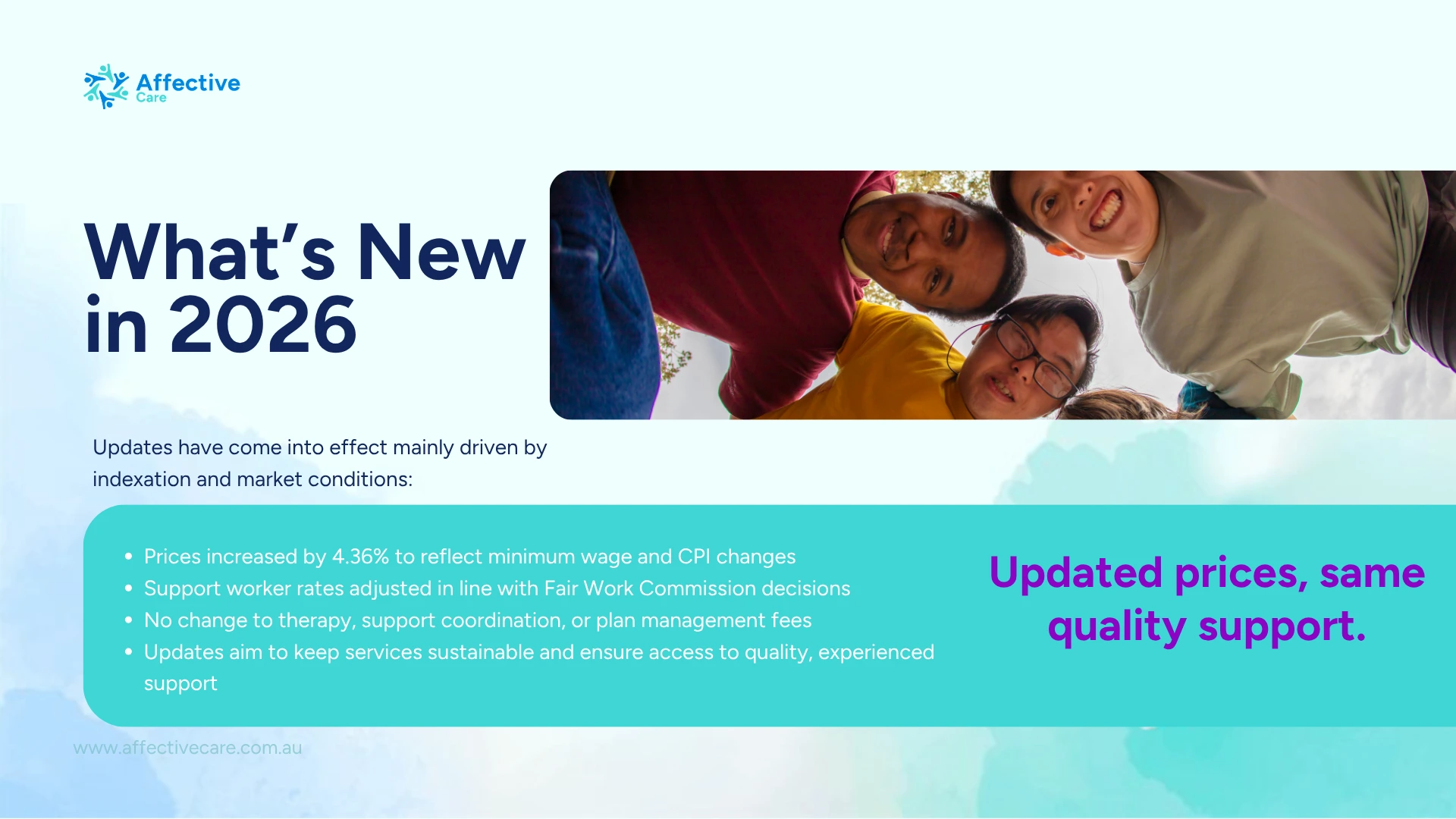
What’s New in the 2026 NDIS Price Guide?
A few key updates have come into effect in the NDIS 2026 Price Guide, mainly driven by indexation and market conditions:
- Indexation adjustment: Prices have been increased by 4.36%, reflecting changes in minimum wage and the Consumer Price Index (CPI).
- Support worker hourly rates have been updated to reflect Fair Work Commission decisions and increased costs for providers.
Some support categories remain unchanged, including:
- Therapy services
- Support coordination (Level 1 and Level 2)
- Plan management fees
These changes aim to keep services sustainable and ensure that participants continue receiving quality support from experienced workers.
To view the official pricing arrangements and catalogue, visit the NDIS website.
Moreover, after checking the NDIS Price Guide, participants can use an NDIS plan implementation checklist to connect price information with their approved supports.
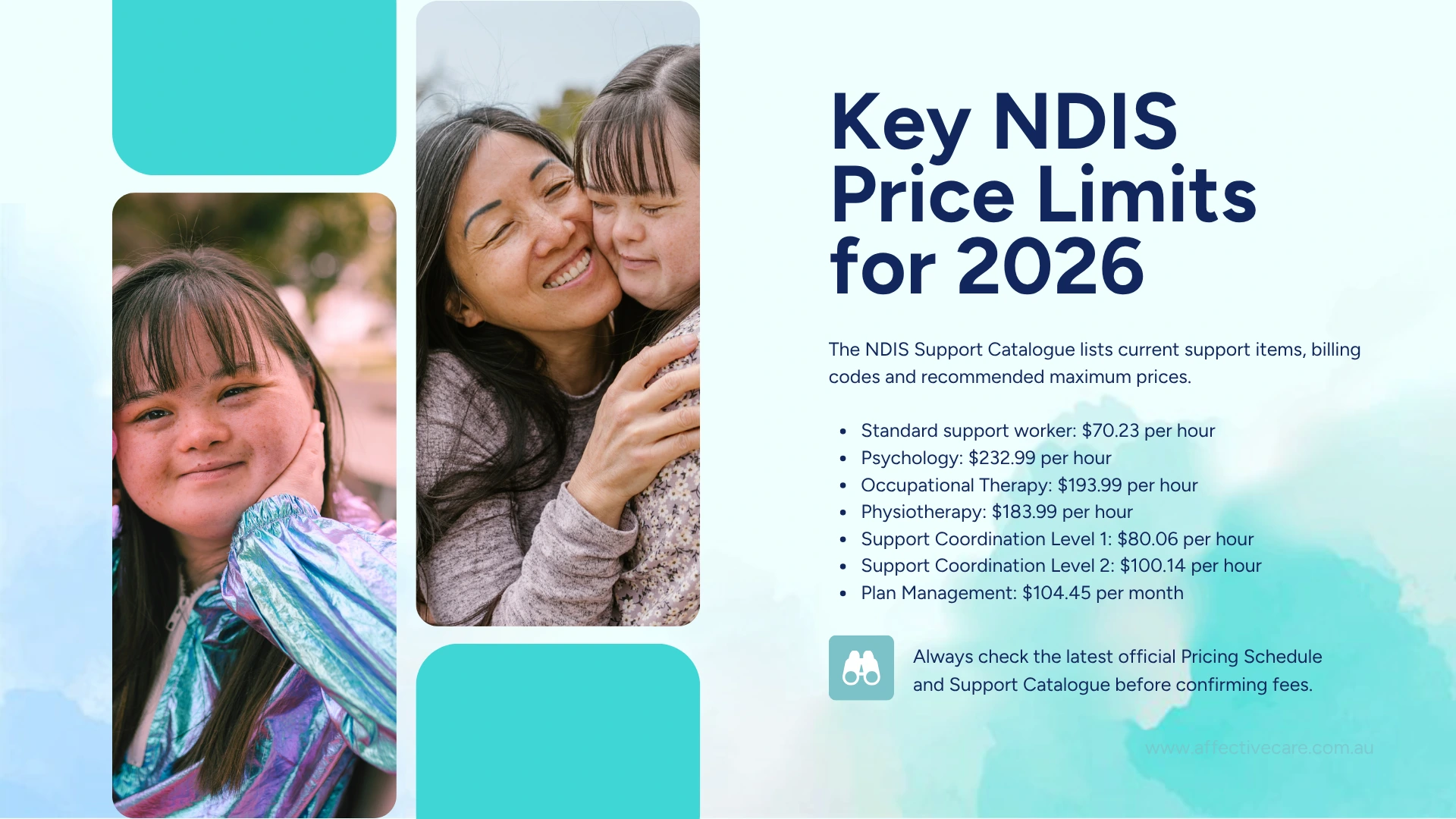
Key Price Limits for Popular Supports in 2026
Below are some of the most searched and used supports under the NDIS Pricing Arrangements 2026:
Core Supports (Daily Activities & Community Access)
| Support Type | Item Code | Hourly Rate |
| Standard Support Worker | 01_011_0107_1_1 | $70.23 |
Capacity Building (Therapy & Coordination)
|
Support Type |
Item Code |
Hourly Rate |
| Psychology | 15_054_0128_1_3 |
$232.99 |
|
Occupational Therapy |
15_056_0128_1_3 |
$193.99 |
| Physiotherapy |
15_055_0128_1_3 |
$183.99 |
|
Dietetics |
12_025_0128_3_3 |
$188.99 |
|
Support Coordination Level 1 |
07_001_0106_8_3 |
$80.06 |
|
Support Coordination Level 2 |
07_002_0106_8_3 |
$100.14 |
The NDIS psychology rate, NDIS physiotherapy fees and Occupational Therapy prices depend on the relevant support item and service location.
The Support Catalogue also shows whether telehealth, provider travel, non-face-to-face work, reports or cancellation claims are permitted for each item.
Providers may charge less than the recommended maximum price, so participants should confirm the actual fee, session duration and additional charges in their service agreement.
Plan Management
|
Support Type |
Item Code |
Monthly Rate |
|
Plan Management Monthly Fee |
14_034_0127_8_3 |
$104.45 |
Note: Always refer to the official catalogue for the most up-to-date pricing.
Where to Find the Latest NDIS Price Guide and Support Catalogue
The official documents are available on the NDIS website.
Participants searching for an NDIS Price Guide 2026 PDF free download can access the official documents through the NDIS website.
The Pricing Schedule is available as a PDF, while the Support Catalogue is provided as a downloadable spreadsheet.
Providers should always check the latest version before preparing service agreements or invoices because pricing guidance and support item details may be updated during the year.
Make sure you download the most recent version, and double-check the release date. Pricing is reviewed annually but updates can occur throughout the year.
Moreover, understanding NDIS price limits can support better budgeting, especially when you are trying to manage essential supports within a limited NDIS plan.

How to Use the NDIS Price Guide and Support Catalogue
To get the most out of the NDIS support catalogue and price guide:
Download the latest documents
- Go to ndis.gov.au
- Search for “Pricing Arrangements and Price Limits 2026”
- Download both the PDF and Excel formats
Find the right support category
- Core supports
- Capacity building
- Capital supports
Locate the support line item
Use the Excel Support Catalogue to find the support name, code, and maximum hourly rate.
| Support service | NDIS support item number | Unit | National rate | Remote rate | Very remote rate |
|---|---|---|---|---|---|
| Standard support worker – weekday daytime | 01_011_0107_1_1 | Hour | $73.58 | $103.01 | $110.37 |
| Standard support worker – weekday evening | 01_015_0107_1_1 | Hour | $81.07 | $113.50 | $121.61 |
| Standard support worker – weekday night | 01_002_0107_1_1 | Hour | $82.57 | $115.60 | $123.86 |
| Standard support worker – Saturday | 01_013_0107_1_1 | Hour | $103.54 | $144.96 | $155.31 |
| Standard support worker – Sunday | 01_014_0107_1_1 | Hour | $133.50 | $186.90 | $200.25 |
| Standard support worker – public holiday | 01_012_0107_1_1 | Hour | $163.46 | $228.84 | $245.19 |
| Night-time sleepover | 01_010_0107_1_1 | Each | $311.79 | $436.51 | $467.69 |
| Personal domestic assistance | 01_004_0107_1_1 | Hour | $61.16 | $85.62 | $91.74 |
| House cleaning and household activities | 01_020_0120_1_1 | Hour | $60.10 | $84.14 | $90.15 |
| House or yard maintenance | 01_019_0120_1_1 | Hour | $59.01 | $82.61 | $88.52 |
| Psychology – direct service | 01_701_0128_1_3 | Hour | $252.99 | $354.19 | $379.49 |
| Occupational Therapy – direct service | 01_661_0128_1_3 | Hour | $193.99 | $271.59 | $290.99 |
| Physiotherapy – direct service | 01_721_0128_1_3 | Hour | $183.99 | $257.59 | $275.99 |
| Speech Pathology – direct service | 01_665_0128_1_3 | Hour | $193.99 | $271.59 | $290.99 |
| Dietetics – direct service | 12_025_0128_3_3 | Hour | $178.99 | $250.59 | $268.49 |
| Podiatry – direct service | 01_663_0128_1_3 | Hour | $188.99 | $264.59 | $283.49 |
| Level 1 Support Connection | 07_001_0106_8_3 | Hour | $80.06 | $112.08 | $120.09 |
| Level 2 Coordination of Supports | 07_002_0106_8_3 | Hour | $100.14 | $140.19 | $150.21 |
| Level 3 Specialist Support Coordination | 07_004_0132_8_3 | Hour | $190.54 | $266.75 | $285.80 |
| Plan Management monthly fee | 14_034_0127_8_3 | Month | $104.45 | $104.45 | $104.45 |
Understand Billing Conditions
- Travel costs: Providers can charge for travel time within certain limits
- Non-face-to-face work: Some preparation or coordination work can be billed if it directly benefits the participant
- Cancellation rules: Short-notice cancellations may still be claimable, depending on timing and reason
NDIS Codes for Invoicing
Providers should use the correct NDIS codes for invoicing when submitting a payment request.
The invoice should clearly show the support item number, service description, delivery date, number of hours or units, agreed price and total charge.
The NDIS billing codes 2026 should match the service that was actually delivered.
Travel, cancellations and non-face-to-face work should be shown separately where the relevant support item permits those claim types.
Knowing the pricing is useful, but it’s equally important to understand how to get Positive Behaviour Support funded by the NDIS before engaging a provider.
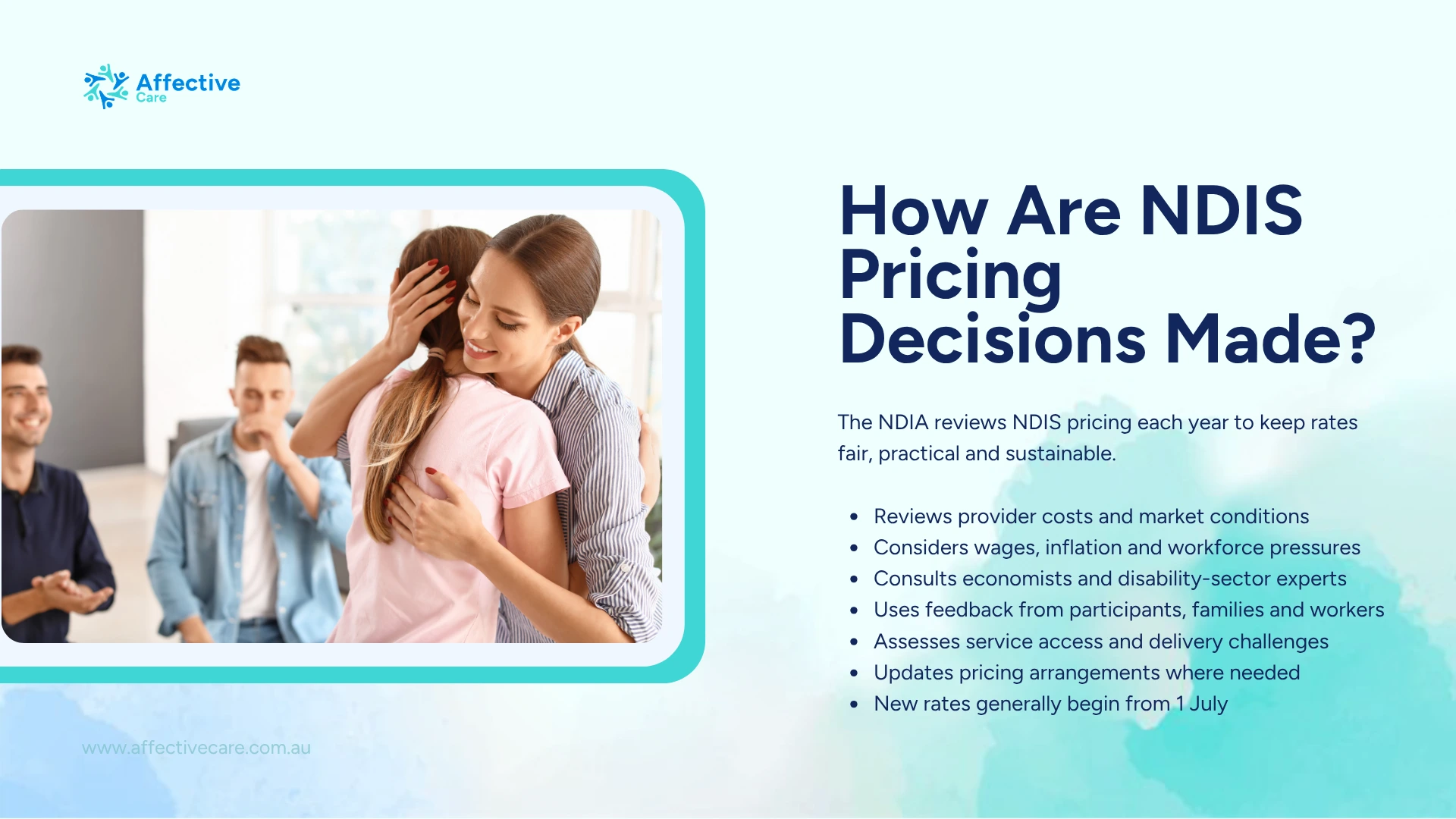
How Are NDIS Pricing Decisions Made?
The NDIS annual pricing review is conducted by the National Disability Insurance Agency (NDIA) to ensure that pricing arrangements remain fair, sustainable, and responsive to changes in the economy and service delivery environment.
To do this, the NDIA gathers information from multiple sources that reflect both economic conditions and the lived experience of the disability community.
It considers market analysis and cost data from service providers across Australia, giving a clear picture of what it costs to deliver quality supports.
The agency also engages with independent economists and experts from the disability sector who help interpret financial trends, workforce pressures, and service delivery models.
Equally important is the feedback received from participants, their families, carers, and frontline support workers.
Their insights help ensure the pricing model is not just financially viable but also practical and responsive to real-world needs.
These elements are reviewed to inform annual updates to the NDIS Pricing Arrangements and Price Limits.
Adjustments are typically announced and come into effect from 1 July each year.
Moreover, to better understand financial responsibilities connected with disability services, you can also read our simple guide to NDIS Taxation.
NDIS Cancellation Policy 2026
The NDIS cancellation policy 2026 allows a provider to claim a short-notice cancellation only when the relevant support item permits the cancellation claim type and the required conditions are met.
The NDIS Support Catalogue identifies which supports can include cancellation claims.
For 2026–27, the short-notice cancellation period for supports not delivered by disability support workers has been adjusted to two business days.
Different conditions may apply to disability support worker-related services, so providers should check the current Pricing Schedule and Support Catalogue before submitting a claim.
Cancellation terms should be clearly explained in the participant’s service agreement, including:
- The required notice period
- Which services may attract a fee
- The amount that may be claimed
- How the cancellation will appear on the invoice
- Whether the provider was unable to fill the booking
A cancellation fee should not be applied automatically to every missed appointment.
Providers must use the correct support item, follow the applicable NDIS billing conditions and keep appropriate records showing why the cancellation claim was made.

Simple Ways to Stay on Track with Your NDIS Plan
Staying compliant with NDIS pricing rules is essential for getting the most out of your funding.
It also ensures that you remain on track with your goals, avoid overspending, and maintain confidence in your providers and agreements.
Here’s how you can better manage your NDIS plan:
Understand the Current Price Guide
The NDIS price guide changes each year, and it’s your go-to reference for knowing what services should cost.
Make it a habit to check the NDIS website or speak with your support coordinator to confirm that you’re working with the correct rates.
Review Service Agreements Carefully
Before signing any service agreement, take the time to carefully read and understand the document.
If you notice a rate that exceeds the allowed maximum NDIS Pricing Arrangement rate, speak to the provider and ask for clarification or an adjustment. It is also important to look into the duration and frequency of supports
Check that the duration and frequency of the supports reflect what was discussed during your planning meeting.
Every detail, including how often the support is delivered and the length of each session, should align with your actual needs.
The language used in the agreement should be clear and accessible. If anything seems vague, technical, or confusing, don’t hesitate to ask for it to be rewritten in plain language.
Finally, if any part of the agreement doesn’t reflect your expectations, goals, or plan priorities, request changes.
You are entitled to understand and feel comfortable with everything you agree to. A clear, transparent agreement builds trust and sets the foundation for a successful support relationship.
Monitor your Invoices and Payments
Being proactive about financial oversight helps prevent billing errors and ensures your funding is used correctly. Each time you receive an invoice from a provider, take the time to compare it with the services you received.
Confirm that the listed supports match the sessions or activities delivered, and check that the rates align with the current NDIS Pricing Arrangements.
Look closely at line items, dates, and times to ensure accuracy. Even small errors, such as double bookings or incorrect durations, can add up and affect your budget.
If anything stands out or doesn’t look right, ask the provider for clarification. It’s always better to address billing issues early, before they become ongoing problems.
Keeping a consistent routine of checking invoices not only keeps you compliant but also builds trust between you and your support team. It shows you’re actively engaged in managing your plan and value the services you receive.
Keep Everything Organised
Organising your documents is one of the simplest yet most powerful ways to stay in control of your plan. When everything is easy to find, plan reviews are smoother, and any unexpected audits or funding questions are less stressful.
- Keep both digital and paper records of important items such as service agreements, invoices, email correspondence, and receipts.
- Use clearly labelled folders—whether physical or digital—to sort documents by provider, service type, or plan period.
- Consider using secure apps or cloud-based tools that allow you to scan, store, and access your files from any device.
Use Tools to Track Your Spending
Many plan managers now offer user-friendly online dashboards or mobile apps that help you monitor how your NDIS budget is being spent in real time. These tools offer several advantages:
- Avoid overspending early in the plan cycle: By tracking your expenses against your budget, you can pace your spending and avoid running out of funds prematurely.
- Identify underused funds: These platforms make it easy to see which parts of your budget aren’t being fully used, giving you a chance to redirect that funding to other supports or activities that could help meet your goals.
- Improve decision-making: Having access to your plan data makes it easier to plan for upcoming services, assess service value, and communicate clearly with your providers.
If you’re not currently using one of these tools, ask your plan manager what options they provide or recommend.
The right platform can give you more control, clarity, and confidence in how your NDIS funds are working for you.
Know What You’re Entitled To
NDIS pricing rules clearly define what providers can bill for. These rules are in place to ensure fairness, clarity, and appropriate use of funding. Some of the key billable items include:
- Travel costs: Providers may claim travel time and expenses when travelling to deliver face-to-face supports, within the specified limits.
- Non-face-to-face supports: Time spent on tasks that directly benefit the participant, such as progress reporting, support planning, and coordinating with other professionals, may be billed if clearly documented.
- Cancellations: If a participant cancels a session with short notice (usually under 2 clear business days), providers may still charge for the time as per cancellation rules.
Understanding what is and isn’t billable gives you confidence in managing your budget.
If a charge seems unclear or unfamiliar, ask for more information and don’t hesitate to request a copy of your provider’s service agreement or pricing breakdown.
Make Sure Billing is Fair
Take the time to confirm that your providers are billing you correctly according to the NDIS Price Guide 2026. This includes checking that:
- Services are charged at or below the maximum allowed rate
- Travel and non-face-to-face time are only billed where appropriate and permitted
- No hidden or unauthorised costs are included
If something seems unclear, it’s your right to ask for a breakdown or explanation. Being assertive in this space helps ensure your funding is used fairly and efficiently.
Transparency and accuracy in billing not only protect your plan but also help build trust between you and your providers.
For a more detailed breakdown of service costs, read our guide on what are typical NDIS price guide rates for support services? and how rates may vary across support types.

Get Support Navigating Your NDIS Funding
If you’re unsure how the NDIS price guide 2026 affects you, or you need help making sense of your budget, we’re here to support you.
At Affective Care, we know that understanding NDIS pricing is not just about numbers. It is about feeling confident that your funding is being used wisely, fairly, and in a way that supports your real life.
Moreover, if you are exploring home and living supports, our Supported Independent Living services explains how SIL can support daily routines, independence and shared living needs.
We take the time to explain pricing, service agreements, and billing in plain language, so you are never left guessing what a line item means or whether a charge is appropriate.
Our team is committed to transparency, clear communication, and participant-first support.
Whether you are reviewing provider costs, trying to understand how far your budget will stretch, or preparing for a plan review, we are here to help you feel informed and supported at every step.


