




NDIS Taxation can feel overwhelming, especially at tax time when participants, support workers, and providers all face different rules. Knowing what’s reportable, what’s claimable, and what’s GST-free often leads to confusion and stress.
This guide simplifies NDIS Taxation so you can confidently meet your responsibilities. Whether you’re a participant managing your plan, a support worker organising deductions, or a provider delivering essential services, understanding your tax obligations is essential. The good news is: you don’t have to navigate it alone.

Are NDIS Payments Taxable for Participants?
This is often the first and most important question: Do you need to pay tax on NDIS funding?
For participants, the answer is generally no. NDIS funding is not considered assessable income and is exempt from tax. That means you do not report it as income when you do your tax return.
What is Included Under This Exemption?
- Funding used to pay for therapies, personal care, equipment, transport, and other supports
- Supports provided through agency, plan, or self-managed models
- Items paid directly to providers or reimbursed to you from your plan
Even though NDIS funds are tax free, you still need to keep detailed records. Invoices, service agreements, and receipts help with plan reviews and NDIA audits.
And just to be clear: you cannot claim tax deductions for NDIS funded items. Because NDIS funds cover these costs, they are not considered your personal expenses, so you cannot claim them as deductions on your tax return.
What’s New in 2025: Important Updates
The NDIS is evolving, and so are the tax rules that surround it. This year brings a few notable changes:
- The GST determination for NDIS funded supports has been extended to 2027
- Plan managers are now adjusting to quarterly funding blocks
- Some pricing arrangements have changed, affecting invoicing and budgets
- The ATO has updated its guidance on classifying support workers
Stay in the loop by checking ATO and NDIA websites throughout the year.
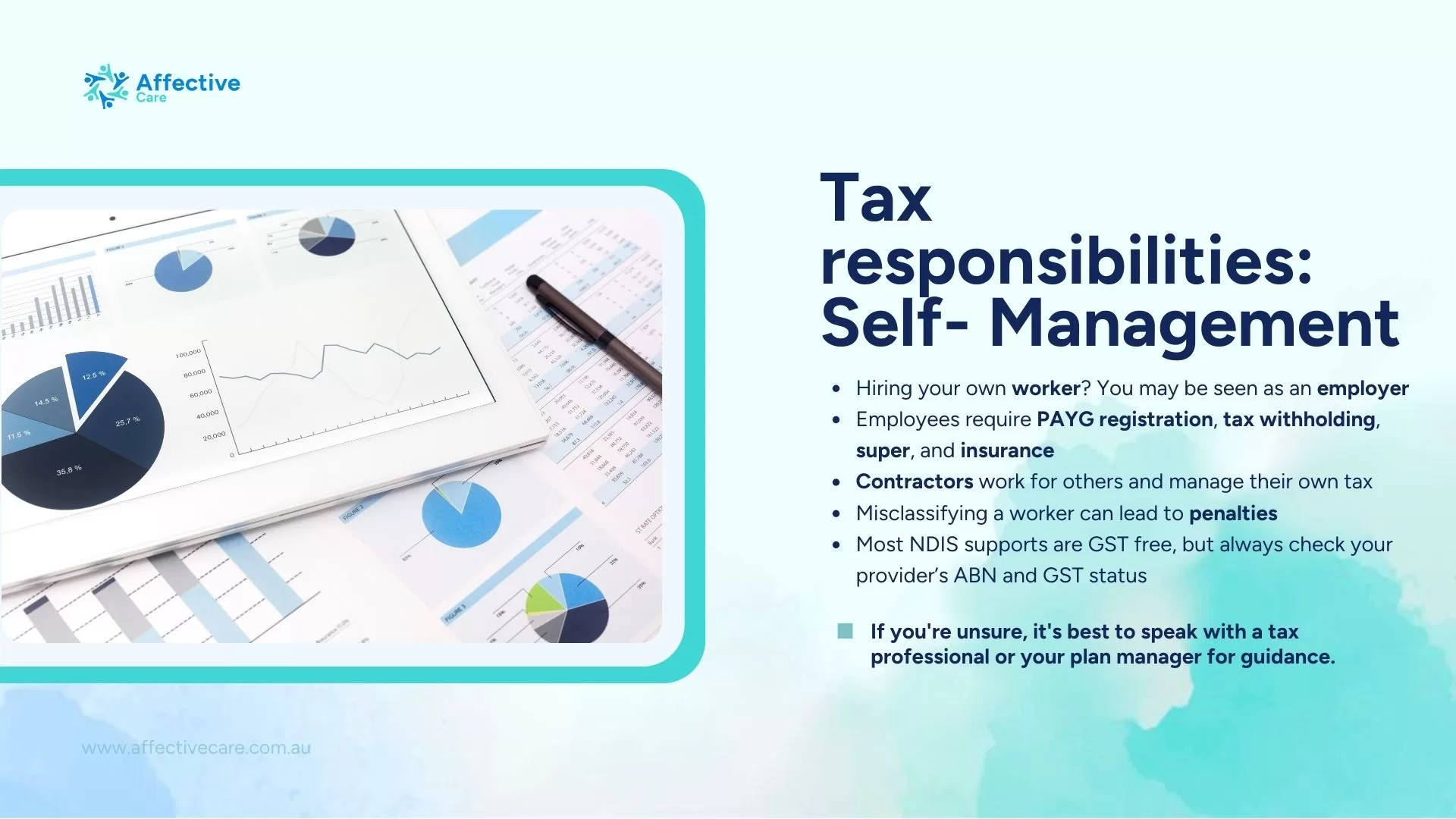
NDIS Self-Management and Tax Responsibilities in 2025
Self-management gives you greater control over your plan, but it also comes with more responsibility, especially if you’re hiring your own workers.
Worker Classification: Employee or Contractor?
Example: Sarah is a self-managed participant who hires Jane to provide daily support. Jane follows Sarah’s routine, does not supply her own tools, and works only for Sarah without issuing invoices. In this scenario, Jane is likely classified as an employee.
As an employer, Sarah would need to:
- Register with the ATO for PAYG withholding
- Withhold tax from Jane’s pay
- Pay superannuation
- Meet any workers compensation or insurance obligations
If Jane worked for multiple clients and issued invoices with an ABN, she might instead be a contractor, in which case she handles her own tax and super.
Why This Matters: Misclassifying a worker can result in fines or unpaid tax liabilities. The ATO offers an online decision tool to help determine the correct classification.
If self-managing, consider speaking with a tax professional to understand your responsibilities and remain compliant.
What is GST and How Does It Apply to NDIS Supports?
GST stands for Goods and Services Tax. It’s a 10% tax added to most goods, services, and other items sold or consumed in Australia. In the context of the NDIS, some NDIS-funded supports are GST-free, meaning providers do not charge GST if certain conditions are met.
GST Considerations
Most NDIS supports are GST free. But not all. If your worker is a contractor who charges GST, you may need to account for that in your plan budget. Always check their ABN status and GST registration.

NDIS Providers: Your GST and Tax Responsibilities
As a provider, you offer services that change lives. But when it comes to tax, there are specific rules you need to follow to keep your business on the right side of the ATO.
When Are Your Services GST Free?
The ATO allows some services under the NDIS to be GST free. To qualify:
- The service must be funded by the NDIS
- It must be reasonable and necessary
- The participant must have an approved plan
- A written agreement or service booking must be in place
If you meet all four, you do not charge GST. But if one is missing, GST may apply. This includes services like room and board, or some transport options.
Keep Your Records Clean
As a provider, make sure to:
- Issue clear invoices that outline the service provided, the date of delivery, and the correct GST treatment. This ensures transparency for both the participant and the ATO.
- Use correct GST codes based on whether the service is GST free under NDIS rules. Misapplying GST can result in overcharging or underreporting.
- Report GST accurately in Business Activity Statements (BAS), which are submitted to the ATO to declare your GST obligations. BAS reports include GST collected, GST paid on business expenses, and other tax details, helping you calculate what you owe or what is refundable.

Tax Deductions for Support Workers
Support work often involves more than direct care. You might travel to multiple participants, complete admin from home, or upskill through professional training. Many of these expenses may be tax deductible.
All income earned from NDIS-related work should be declared in your tax return, regardless of whether you’re a sole trader or employee. Not all support workers have the same tax rights or responsibilities. Employees have a limited scope for claiming deductions and rely on employer-provided summaries like PAYG statements. Contractors or sole traders, on the other hand, are responsible for declaring their full income and may be eligible to claim a wider range of deductions related to their business operations.
Eligible Work-Related Deductions
Support workers can usually claim expenses for:
- Travel between participant appointments (excluding commuting to or from home)
- Uniforms and protective gear, including laundering costs
- Job-related training or courses
- Professional indemnity insurance
- Home office expenses for admin or remote work
- A portion of phone or internet bills used for work communication
To be eligible, the expenses need to be paid out-of-pocket, not reimbursed, and properly documented with receipts or logbooks.
Example: Luke, a casual support worker, drives between participants, wears a required uniform, uses his phone to coordinate shifts, and completes admin from home. Because these are necessary for his work and not reimbursed, Luke can claim them on his tax return.
If you’re unsure about your deductions, a tax agent familiar with community and disability services can provide tailored advice.
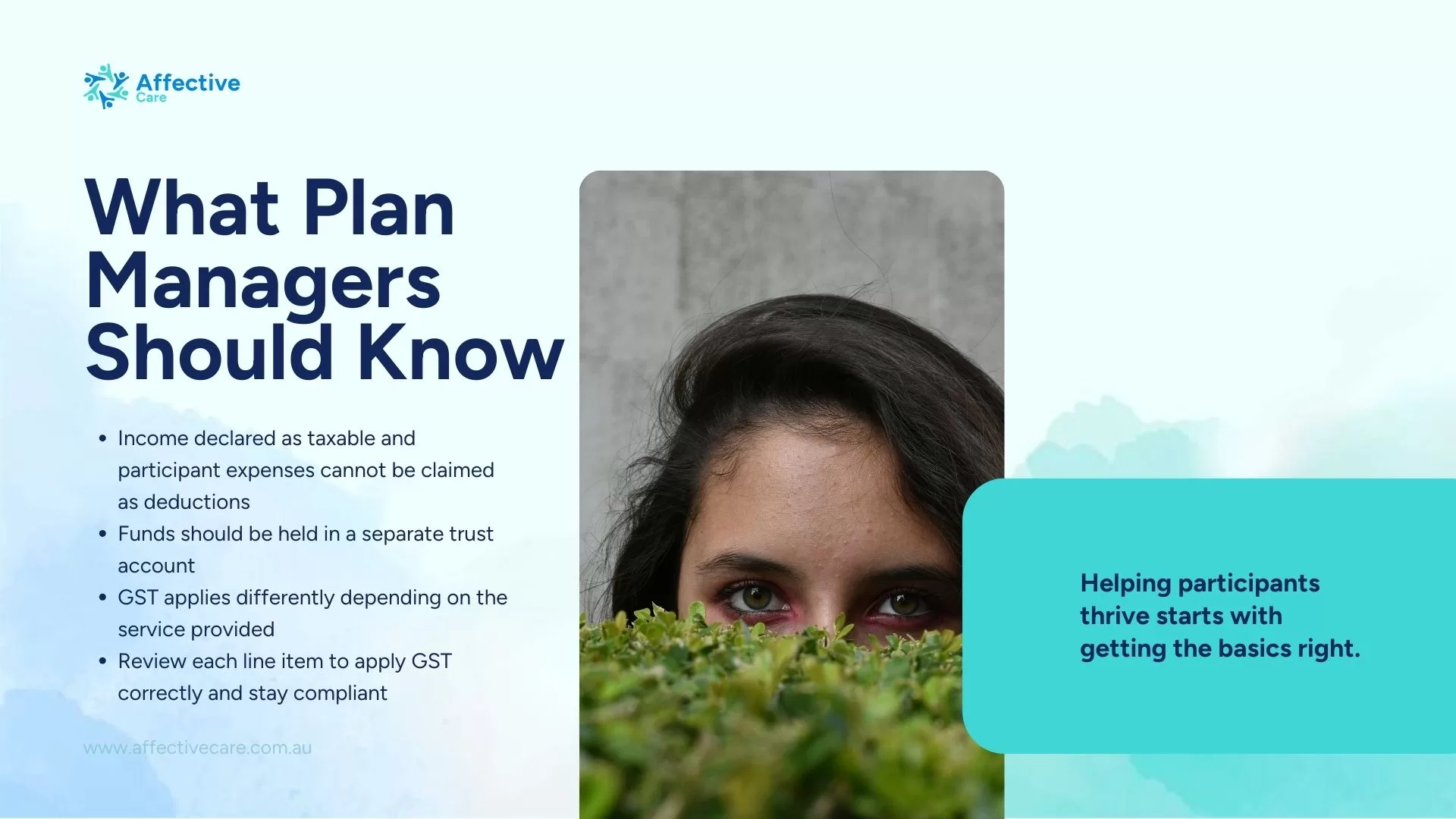
What Plan Managers Need to Know
If you are a plan manager, you handle other people’s money. That brings a lot of trust, and with it, a high level of responsibility.
Tax Tips for Plan Managers
- Income earned from plan management services is taxable and should be reported
- You cannot claim participant expenses as deductions
- Funds should be kept in a separate trust account
Plan managers also need to manage GST carefully. Some of your services may be GST free, while others are not. Review each line item closely.
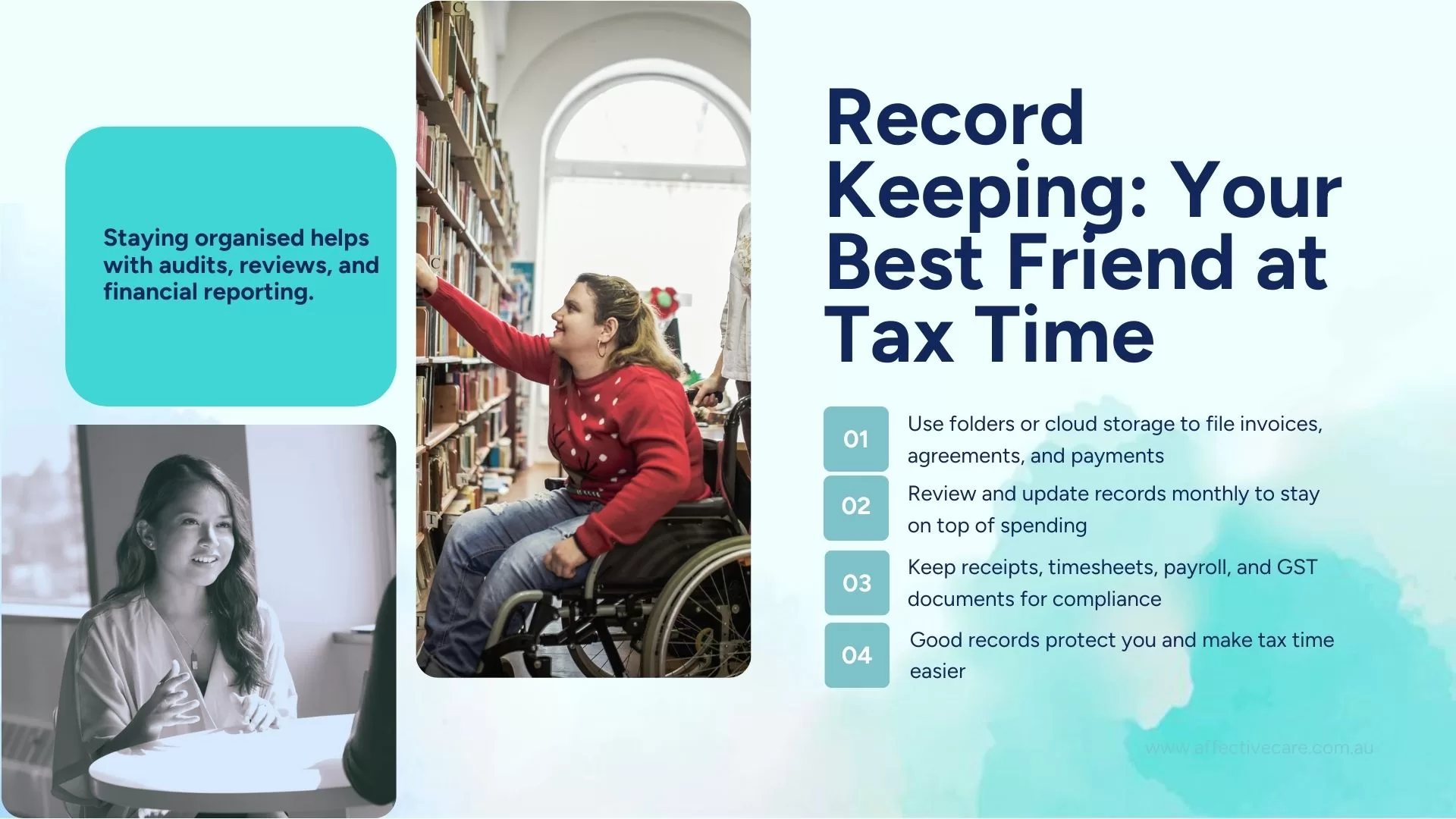
Record Keeping: Your Best Friend at Tax Time
Organised records are essential. They protect you during audits, support accurate reporting, and bring clarity to your finances.
Audit Tip: If the ATO or NDIA requests evidence, having a digital folder system can speed up your response. Consider organising your files into categories like Invoices, Agreements, Worker Payments, and GST Statements. Cloud storage options like Google Drive or Dropbox can make this easy to manage from your phone or computer.
Planning Tip: At the end of each month, set aside 30 minutes to review receipts and update your records. It saves time at tax time and keeps your business or plan running smoothly.
Whether you are a participant, provider or worker, keeping good records is key. It helps you:
- Track spending
- Meet reporting obligations
- Avoid disputes
- Prepare for audits
What Should You Keep?
You should retain a complete and well organised record of all your NDIS related financial documents. This includes invoices for services you have delivered or received, service agreements that outline the scope and terms of support, and timesheets that track hours worked. Payroll records are essential if you employ staff, as are documents relating to superannuation contributions and tax obligations. Keeping these documents secure and accessible will help you prepare for audits, track spending, and meet your ongoing reporting requirements.

When to Seek Help
Tax is tricky, and no one expects you to be an expert. If you are feeling unsure, it might be time to reach out.
Consider Speaking to a Professional If:
- You are self-managing and hiring your own team
- You are unsure whether your worker is an employee or contractor
- You are running a support business and need clarity on GST
- You are a support worker and want to maximise deductions
Final Thought
Tax and disability support may seem like an unlikely pair, but financial clarity is an essential part of strong support. But the truth is, financial clarity is part of strong support. Understanding your obligations helps you protect your funding, your team, and your peace of mind.
Whether you are navigating the NDIS as a participant, provider, or support worker, remember that support exists for you too. Keep good records, ask for help when needed, and know that every step you take strengthens your foundation.
Disclaimer
The information provided in this article is for general informational purposes only and does not constitute professional advice. It should not be relied upon as a substitute for financial, legal, or taxation advice.
NDIS-related taxation matters can be complex and may vary depending on your individual circumstances. We strongly recommend that you consult with a qualified tax professional or financial advisor before making any decisions related to your taxation obligations.
Affective Care accepts no responsibility for any loss, liability, or damage incurred as a result of reliance on the information contained in this article.


