



NDIS SIL rent is one of the most common areas of confusion for people living with disability, families, and support coordinators.
Many people want to know whether the NDIS pays rent, how much they personally need to contribute, and how SIL differs from SDA.
This guide provides a clear explanation of how NDIS SIL rent works, what the NDIS funds are, what remains a personal cost, and how these contributions look in everyday situations.
You’ll also find simple examples, practical tips, and helpful questions to ask providers so you can feel more confident and informed when making decisions about your housing and support.
What is SIL? (SIL NDIS Meaning)
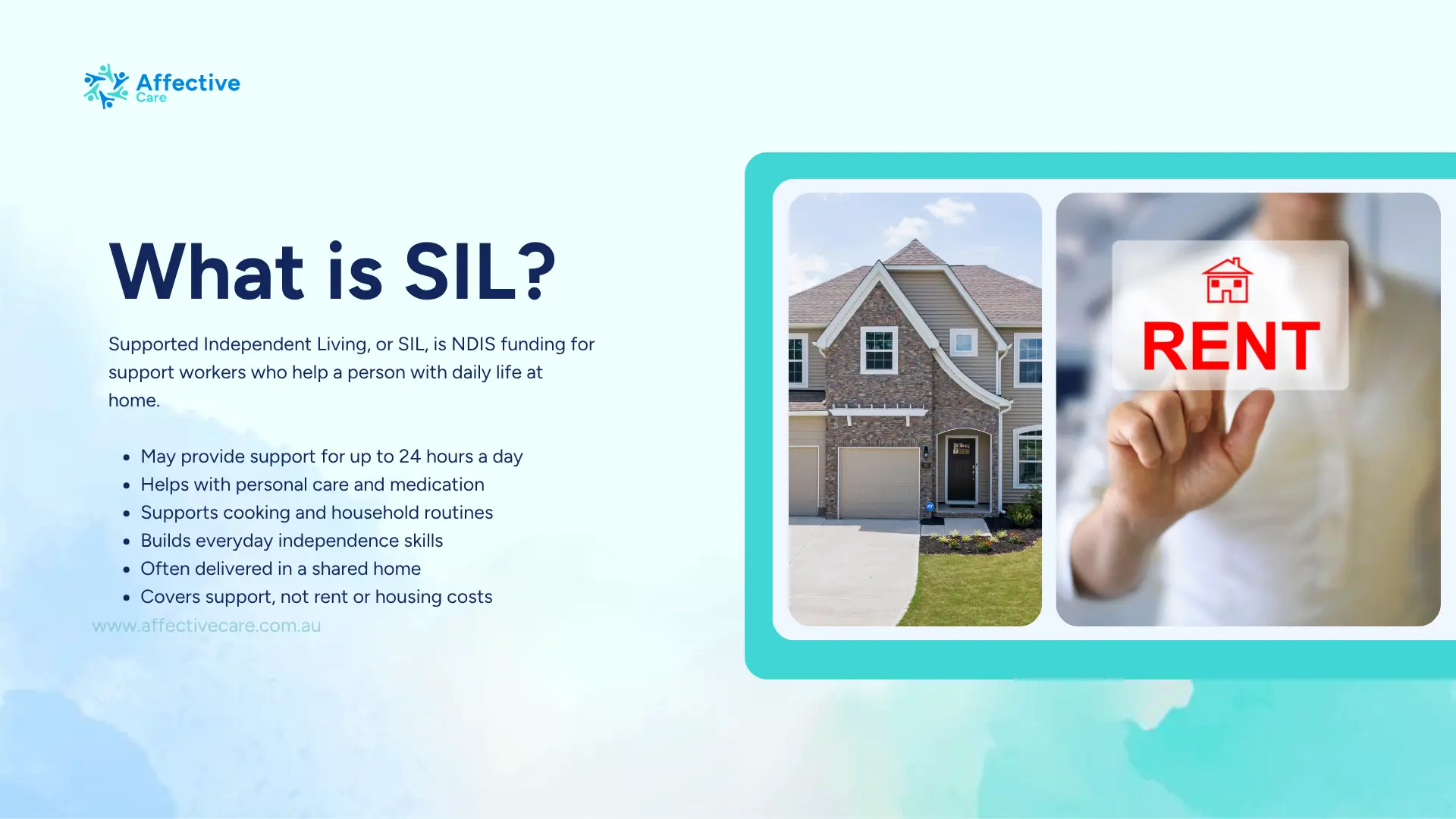
SIL stands for Supported Independent Living; NDIS funding for support workers who help a person with daily life in their home, often up to 24 hours a day.
The SIL NDIS meaning is frequently misunderstood: SIL pays for the support, never the housing.
A “SIL house” is simply an ordinary home usually shared by two or three participants where that support is delivered.
In practice, SIL covers help with personal care, cooking, medication, household routines and building independence skills, delivered by a roster of support workers.
The home itself, and the rent for it, sit outside SIL funding which is exactly why this page exists.

Quick Answer: Do You Pay Rent in NDIS SIL Housing?
People often ask, “Do you pay rent in SIL?” or “Does the NDIS pay for rent?” The short answer is:
Yes, you usually pay rent when living in a Supported Independent Living (SIL) arrangement.
The NDIS does not fund general rent or mortgage payments. Instead, your rent or board usually comes from your Disability Support Pension (DSP) or other personal income.
However, the NDIS may fund parts of your housing if they relate directly to disability support needs. Here are a few examples;
- SIL (the staff support in your home)
- SDA (Specialist Disability Accommodation) for eligible participants
- Short-Term Accommodation or Medium-term Accommodation when there is a disability-related need
NDIS rental assistance does not usually cover ordinary rent or mortgage payments.
Participants generally pay accommodation costs from personal income, while the NDIS may fund disability-related supports delivered in the home.
If you have come across confusing funding claims online, our guide to what the NDIS $15,000 holiday in Australia actually means and whether it applies to participants may help clear things up.
If you are in SDA housing, your rent is capped through the reasonable rent contribution rules. This helps keep housing affordable. Put simply:
- SIL = Support workers
- SDA = The building
- Rent = What you pay

Understanding the Difference Between SIL, SDA, and General Rent
Many people feel confused about NDIS housing options, especially when comparing SIL, SDA, and ordinary rental costs.
A simple way to understand SIL vs SDA: SDA is the home; SIL is the support team inside the home.
Supported Independent Living (SIL)
To understand SIL meaning in the NDIS, think of SIL as the funded supports that help you live as independently as possible.
SIL is not the building, it is the team of support workers who assist you in daily life. SIL may include:
- Assistance with daily living and personal care
- Help with cooking, cleaning, and home routines
- Medication prompting
- Support with community access and goal-focused activities
You can receive SIL in different types of housing, private rentals, family homes, SDA dwellings, or other arrangements.
This is why the concept of NDIS SIL rent often confuses: SIL funding covers support, not accommodation or rent costs.
Specialist Disability Accommodation (SDA)
SDA refers to the specialist building designed for people with very high support needs or extreme functional impairment.
Homes may include accessible bathrooms, reinforced structures, assistive technology, and space for on-site supports.
SDA and SIL are separate funding categories, and you may receive:
- SIL without SDA
- SDA without SIL
- Or both together
General Rent
General rent is an everyday living cost that the NDIS does not typically fund. This includes:
- Private or community housing rent
- Mortgage repayments
- Standard utilities
If you receive SIL in a private rental or family home, NDIS SIL rent remains a personal living expense.
Understanding the difference between SIL vs SDA helps explain why NDIS SIL funding cannot be used to pay rent and how each support works together to create the right living arrangement.
To better understand the day-to-day structure of Supported Independent Living, including support arrangements and living options, read how SIL accommodation works.

How NDIS SIL Rent and Board Contributions Usually Work
Supported Independent Living (SIL) funding covers only the support workers who assist you in your home. It does not cover any everyday living expenses.
This means that costs such as rent, food, utilities, and personal items must still be paid from your own income, which may come from the Disability Support Pension, Youth Allowance, wages, or other financial supports.
Because SIL homes operate like any shared or private household, participants usually contribute to the ongoing costs of living in the home.
These contributions are sometimes referred to as “rent and board,” “rent and utilities,” or simply “household contributions,” depending on the provider.
The NDIS requires that these charges be fair, transparent, and clearly outlined in your service agreement or tenancy documents.
NDIS Shared Living Arrangements
NDIS shared living arrangements may involve two or more participants living together and sharing some scheduled supports. Each resident should still have an individual plan, personal goals and clearly documented support needs. Shared living does not mean every support must be delivered as a group, as participants may receive a combination of shared and individual assistance.
Before moving into a shared home, ask how staffing ratios, overnight support, household costs, compatibility and private time will be managed.
Assistance With a Shared Living Arrangement
Assistance with a shared living arrangement may include help with personal care, cooking, household routines, medication, overnight support and building independent living skills.
Funding is based on each participant’s assessed disability support needs and should not be used to cover rent, groceries or standard household bills.
The arrangement should clearly explain:
- Which supports are shared
- Which supports are delivered individually
- The expected staffing ratio
- How overnight assistance is provided
- What happens when a housemate is away
- How changes are recorded in the service agreement
Common NDIS SIL Rent and Board Structure
Most SIL providers follow a similar approach, in which participants contribute part of their income toward everyday living costs.
This is because SIL funding covers only support workers, not the home’s cost of living.
According to NDIS guidance, rent, food, utilities, and other day-to-day expenses are always personal living costs and cannot be paid using SIL funding.
Participants usually contribute to three main areas of household costs.
Rent
Rent is treated the same as in any private or shared rental. It is a personal expense paid from the Disability Support Pension or other income.
The amount must be clearly outlined in your tenancy agreement or service agreement so you understand exactly what you are paying for.
Utilities
Households also share the cost of essential services. This typically includes electricity, water, gas, and the internet.
These costs are usually split evenly between housemates or calculated based on actual bills. Moreover, providers must be transparent about how these amounts are determined.
Shared Household Items
Many SIL homes include basic consumables used by everyone. Common examples include;
- Cleaning products
- Toilet paper
- General kitchen items
These may be grouped under “board” or “household contributions” to simplify payments.
SIL emphasises that all costs must be fair, reasonable, and fully explained before a participant signs any agreement.
Charges must reflect real household expenses and cannot be used to cover staffing or support costs.
The Key Rule
Your NDIS SIL rent and board must always be clearly stated in your written Service Agreement.
Because every provider is different, it’s essential to ask questions such as;
- What does “board” include?
- Are utilities included?
- Can fees change, and how often?
- How is the amount calculated?

Reasonable Rent Contribution in SDA: The common 25% + CRA Formula
If you live in SDA, your rent is capped by the reasonable rent contribution (RRC) rules. These rules help keep specialist housing affordable for people with high support needs.
A reasonable rent contribution under the NDIS applies specifically to Specialist Disability Accommodation, not ordinary SIL housing.
An SDA provider cannot charge more than the Maximum Reasonable Rent Contribution set under the SDA pricing arrangements, although residents may still need to pay utilities and other everyday living costs.
Typical Formula Used in SDA
Most SDA providers follow a standard contribution structure, which provides a stable, predictable weekly or fortnightly cost.
- 25% of the base Disability Support Pension (DSP)
- + 100% of your Commonwealth Rent Assistance (CRA)
Simple Example
This is an illustration only; real figures change over time.
- If your DSP base rate is approximately $1,100 per fortnight
- 25% = around $275
- Plus full CRA entitlement (for example, around $190)
You would contribute approximately $465 per fortnight. This goes to the SDA provider as your rent contribution.
The NDIS then pays the SDA funding directly to the provider to cover the specialist features of the home.

What will NDIS Pay and won’t Pay for your Housing?
The phrase “NDIS housing options package” is commonly used to describe a combination of assessments, planning and funded supports that help a participant explore where and how they may live.
It is not usually one standard package or fixed funding amount.
What NDIS Usually Does NOT Pay For
- General rent
- Mortgage repayments
- Groceries
- Standard utilities
- Household furniture
- Personal costs
What NDIS Pays for
- SIL (staff support in your home)
- SDA (for eligible participants)
- Home modifications
- Short Term Accommodation (STA)
- Medium Term Accommodation (MTA)
- Individualised Living Options (ILO) supports
- Assistive technology or equipment
If you are exploring location-based SIL options, you can learn more about our SIL homes in Sydney to see how daily support, safe housing and participant-centred care can work together in a supportive home environment.

How Much will I Actually Pay? Common Scenarios for SIL and SDA
Every person’s situation is different, but the examples below can help you understand typical outcomes.
Scenario 1: Living in a Shared SIL Home
You receive SIL funding and live in a shared home with other participants. You may pay for:
- Rent
- Utilities
- Shared household items
- Board (depending on the provider)
This usually comes from your Disability Support Pension or other income. SIL funding covers the support workers, not the cost of the house.
If you are still unsure how housing, supports, and personal costs fit together, our guide to NDIS funding and how different support budgets work across housing, daily supports, and disability-related needs can help make the bigger picture clearer.
Scenario 2: Living in SDA with SIL Supports
You have SDA in your plan and live in a specially designed home with SIL supports. Meanwhile, NDIS covers the SDA funding directly. You pay for:
- Your reasonable rent contribution (e.g. 25% of DSP + 100% CRA)
- No additional amount for the SDA dwelling itself
Scenario 3: Receiving SIL in a Private Rental
You rent your own unit or house privately. The NDIS only pays for your SIL supports.
In all cases, your personal financial circumstances influence how affordable each option feels, so budgeting is important.
Here is what you pay for;
- Market rent
- Utilities
- All normal tenancy costs
NDIS Housing for Rent
People searching for NDIS housing for rent may find SIL vacancies, SDA dwellings, private rentals or community housing options.
It is important to check whether an advertised property is ordinary housing with support available, an enrolled SDA dwelling or a provider-operated SIL home.
Before applying, confirm:
- The weekly rent or board contribution
- Whether utilities are included
- Whether the property is SDA-enrolled
- Which support provider works in the home
- Whether residents can choose or change providers
- Whether the tenancy and support agreements are separate
What You Pay For vs What the NDIS Pays For — Full Breakdown
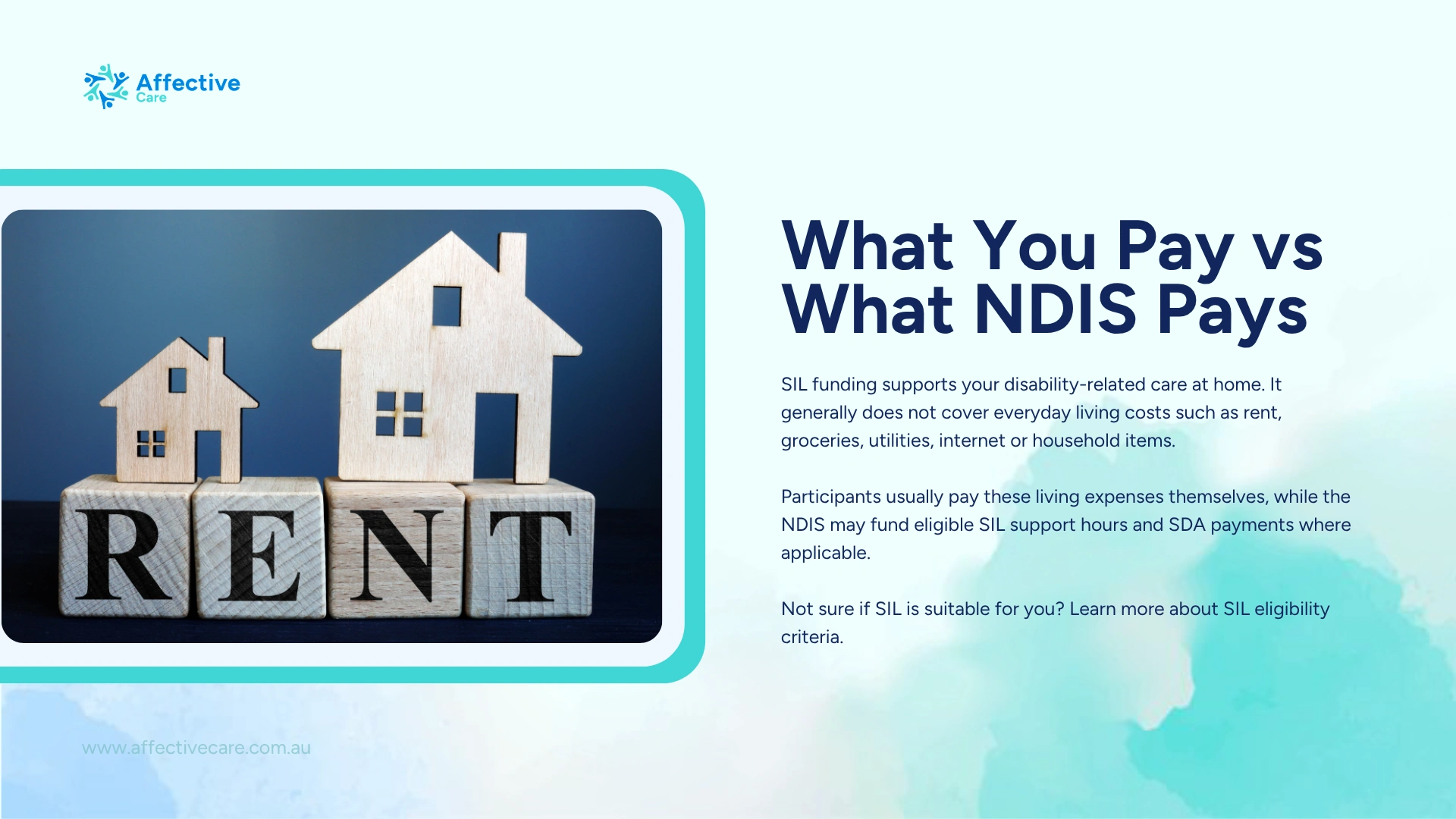
SIL funding is for the disability-related support you need at home. It does not usually pay for ordinary living expenses such as rent, groceries or household bills.
The table below gives a simple breakdown of who generally pays for common SIL and housing costs.
The NDIS confirms that SIL does not include rent, board, lodging or groceries, while eligible SDA participants generally pay a reasonable rent contribution and their everyday living costs.
| Cost | Who usually pays? | Typical amount |
|---|---|---|
| Rent / board | Participant | Depends on the property and housing arrangement |
| Utilities | Participant | Based on household usage and agreed arrangements |
| Groceries | Participant | Based on individual household expenses |
| Household consumables | Participant | Based on household needs and agreed sharing arrangements |
| Internet | Participant | Based on the chosen internet plan and household arrangement |
| Contents insurance | Participant | Depends on the insurer and level of cover chosen |
| Transport | Participant or NDIS, depending on the support | Depends on the participant’s circumstances and NDIS plan |
| SIL support hours | NDIS, where included in the participant’s plan | Depends on approved support needs, hours and staffing arrangements |
| SDA payment | NDIS for eligible SDA funding; participant pays their applicable rent contribution | Depends on SDA eligibility, dwelling and applicable pricing arrangements |
Not sure whether SIL may be suitable for you? Eligibility depends on your individual support needs and circumstances. Read our guide to Supported Independent Living eligibility criteria for a clearer explanation.

Planning Your NDIS Housing Budget
Moving into SIL or SDA is an important life decision, and having a clear budget can help you feel organised, confident, and in control of your finances.
When planning your budget, it’s helpful to consider all regular and occasional expenses, not just rent. Typical costs to plan for include a few things, like:
- Rent or rent and board
- Electricity, gas, water, and internet
- Transport costs, such as fuel, taxis, public transport, or disability transport
- Medication and medical expenses that the PBS doesn’t cover
- Personal items, including clothing, toiletries, and household needs
- Recreational and social activities, such as outings, hobbies, or memberships
- Food and groceries, whether you shop independently or contribute to shared meals
- Phone plans or device costs, which are often overlooked but essential
Creating a simple fortnightly or monthly budget can help you see how much remains after essential costs and whether your current living arrangement is financially sustainable.
Budgeting also makes it easier to plan for unexpected expenses or changes in income.
If you’re unsure where to start, it can be helpful to talk with people who understand NDIS housing and financial supports. These may include:
- Your support coordinator, who can help you understand your options
- Your plan manager, who can support you with tracking NDIS-funded expenses
- A financial counsellor, who can help you manage personal income, debts, and long-term budgeting
If you are comparing SIL options by location, our guide to SIL homes in Canberra (ACT) can help you understand what supported living may look like in a safe, comfortable and participant-centred home environment.

How to Talk with Providers about Rent and Your Rights
Feeling comfortable when discussing rent is important. You have the right to ask questions and receive clear answers.
Helpful Questions to Ask Providers
- What exactly does “board” include?
- Are utilities included in the rent and board?
- How often can fees change?
- What happens if my income changes?
- Will I receive a breakdown of all charges?
- Is this a lease agreement, a service agreement, or both?
If you are living in SDA, remember that rent is capped under the reasonable rent contribution rules.
You are not alone when navigating your housing rights. If you ever feel unsure or pressured, you can speak with:
- Tenant advocacy services
- Disability advocates
- Your support coordinator
These guides can help you ask the right questions and keep important information organised: Questions to Ask Before Choosing an NDIS Provider covers key provider considerations, while the NDIS Record Keeping Guide can help you maintain clear records of agreements, costs and important documents.
Get It in Writing: The Two Agreements That Protect You
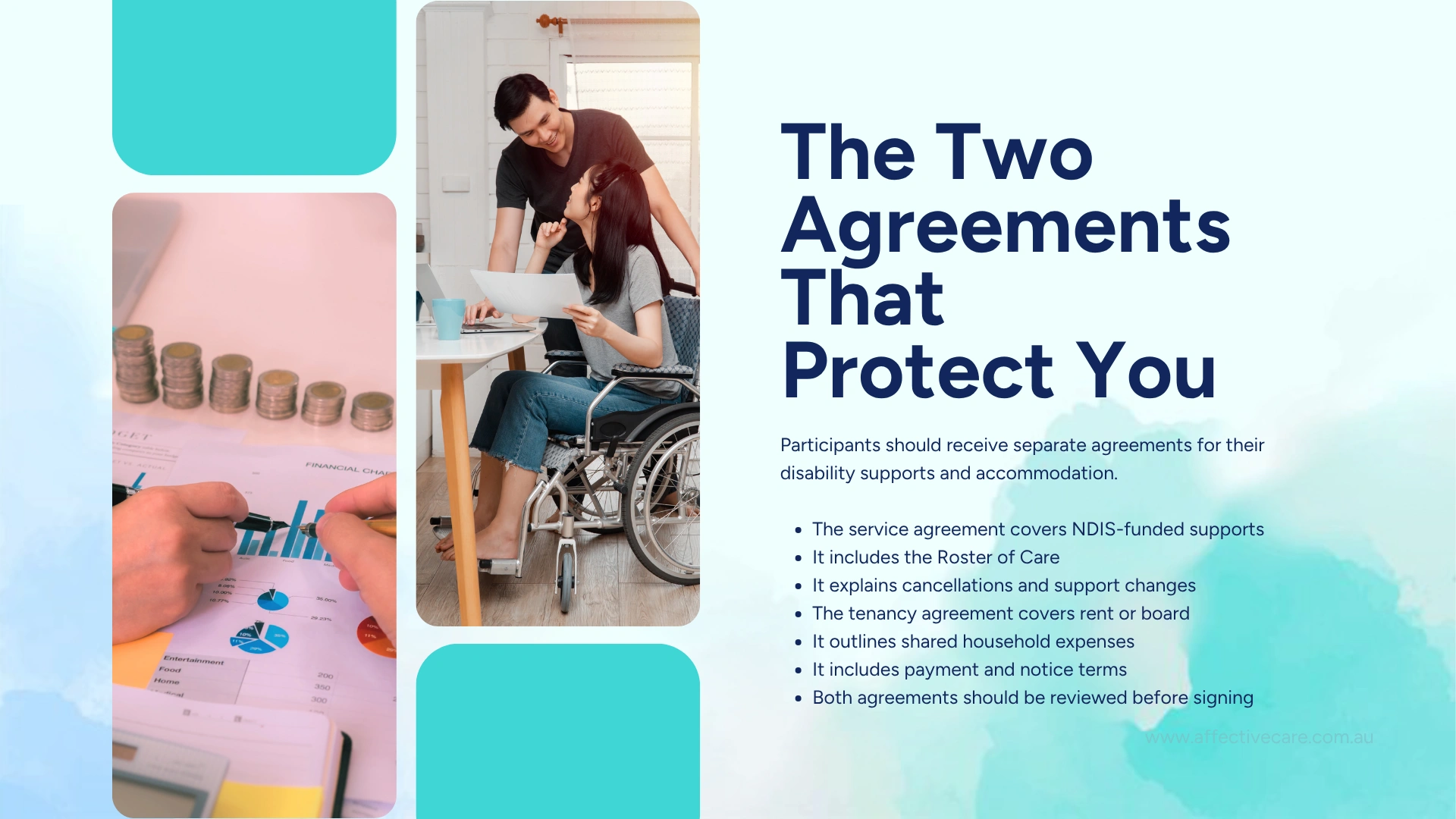
SIL support and your housing are two different arrangements, so they should be clearly documented separately.
Where the same provider delivers both SIL support and the tenancy, current NDIS Commission SIL Practice Standards require separate service and tenancy agreements, and participants should be supported to understand that one agreement is not dependent on the other.
1. Your Service Agreement
Your service agreement covers your NDIS-funded supports. It should clearly explain what support you will receive, how it will be delivered and what happens if your circumstances change.
Check that it clearly states:
- your agreed support hours;
- your staffing or SIL support ratio;
- how changes to your support needs will be reviewed;
- cancellation and notice requirements; and
- how you can change or end your SIL support arrangements.
The NDIS Commission also expects SIL service agreements to explain how changes in a participant’s circumstances or support needs will be agreed and communicated.
2. Your Tenancy or Occupancy Agreement
Your tenancy or occupancy agreement covers your home. It should clearly state your rent or board amount, any bond, what is included in your payments, how shared household costs are calculated, your notice requirements and what happens if you decide to leave.
It should also help you understand your rights and responsibilities as a resident, including your housing security and the process for ending the tenancy.
Why the Two Agreements Should Be Separate
Keeping the agreements separate protects your choice and control.
Changing your SIL provider should not automatically mean losing your home.
The NDIS Commission specifically requires participants receiving both tenancy and SIL from the same provider to understand that the two agreements are legally separate and that one is not contingent on the other.
If a provider gives you one document that bundles your accommodation and SIL supports together, ask them to explain why and request clear, separate documentation before signing.
Five Things to Check Before Signing
Before agreeing to anything, check:
- What you will pay — rent, board, bond, utilities and other household costs.
- What supports you will receive — including support hours and staffing ratios.
- The exact notice periods — for cancelling supports, changing providers or leaving the property.
- What happens if your needs change — including how your support arrangements will be reviewed.
- Your exit rights — including what happens to your tenancy if you change SIL providers.
Take the agreements away and read them carefully with a family member, advocate, support coordinator or another person you trust if that helps you make an informed decision.
If you have already signed an agreement and are unsure about what it means, ask your provider for a copy and request an explanation in a format you understand.
You can also seek independent advocacy or legal advice and review the NDIS Quality and Safeguards Commission guidance on SIL tenancy, housing and support arrangements.

Steps to Check if You’re Getting the Right Housing Support in Your NDIS Plan
If you’re unsure whether your current housing truly meets your needs, reviewing your plan can help you move from confusion to clarity.
Understanding what is included, SIL, SDA, ILO, or temporary housing supports, allows you to take informed action.
Review What’s Already in Your NDIS Plan
Start by checking whether your current plan includes the main NDIS housing options, such as:
- NDIS Supported Independent Living (SIL)
- Specialist Disability Accommodation (SDA)
- Individualised Living Options (ILO)
- Short Term Accommodation (STA)
- Medium Term Accommodation (MTA)
Update Your NDIS Housing Goals
Your NDIS housing goals should reflect your current needs for independence, safety, and daily living. You may need updated goals if:
- Your living situation has become unsafe or inaccessible
- You require more support than before
- You want to explore SIL, SDA, or ILO options
Gather Functional Evidence
High-quality evidence is essential, especially when checking SDA eligibility or requesting changes to SIL. Their assessments help demonstrate your support needs.
Here are Professionals who can assist:
- Occupational therapists
- Psychologists
- Support coordinators
- Behaviour practitioners (if relevant)
Discuss Concerns Early
Speak with your support coordinator or LAC if you feel your housing supports aren’t meeting your needs. Early conversations make it easier to:
- Prepare for plan reassessments
- Gather required documentation
- Explore alternative housing pathways

When to Ask for Help and Who to Talk to
It’s completely normal to feel unsure about NDIS SIL rent, SDA rules, or your NDIS housing options.
These areas can be complex, and you don’t have to work through them on your own.
Reaching out early, especially if you’re unclear about your rent, considering a move, or worried about affordability, can help you make confident decisions before challenges build up.
If you need NDIS housing advice, the following people can support you:
- Support coordinators help you understand SIL, SDA, and ILO and guide you through plan reviews or housing changes.
- Local Area Coordinators (LACs) explain what’s in your plan and support you to prepare for reassessments.
- Disability advocates provide independent advice if you’re unsure, feel pressured, or want help understanding your rights.
- Financial counsellors assist with budgeting, planning for rent, and managing personal expenses.
- The NDIS helpline answers general questions about housing supports, funding rules, and eligibility.
Reach out for help if you are:
- Unsure what your rent includes
- At risk of falling behind on payments
- Considering SIL or SDA housing
- Checking SDA eligibility
- Needing clarity about your housing supports

Why Choose Affective Care for NDIS SIL Rent Support
Affective Care provides precise, reliable guidance to help you understand your NDIS SIL rent responsibilities and make confident decisions about your housing options.
Here’s how Affective Care helps you:
- Clear explanations of NDIS SIL rent and board so you always understand what you pay and what your NDIS funding covers.
- Up-to-date guidance based on NDIS Pricing Arrangements, explained in simple, everyday language.
- Support comparing NDIS SIL providers to help you choose the most suitable and affordable option.
- Transparent discussions about rent, utilities, and household contributions to help you budget confidently.
- Experienced team across SIL, SDA, ILO, STA, and MTA for complete NDIS housing support.
- Personalised planning that aligns your goals, functional needs, and evidence with the proper supports.
- Close collaboration with your support coordinator, plan manager, and family.
- A participant-first approach that makes your housing journey clearer, calmer, and more supported.

Ready to Talk Through Your SIL Rent Options with a Friendly Expert?
If you’d like warm, clear guidance tailored to your situation, our team at Affective Care is here to help.
We take the time to explain NDIS SIL rent and SDA in simple, everyday language and help you explore your housing options with confidence.
You’re welcome to reach out for a friendly conversation or book a free consultation.
Together, we can review your needs, support your goals, and ensure you understand your choices.


