NDIS telehealth means getting your NDIS-funded therapy by video call or phone instead of in person. Under the NDIS Pricing Schedule 2026–27, telehealth therapy now has its own support items, charged at the same hourly price limit as face-to-face sessions.
Psychology, positive behaviour support, counselling, occupational therapy and speech pathology can all be delivered by NDIS telehealth.
This guide explains the NDIS telehealth rules for 2026, the new telehealth line items, what each therapy costs, how NDIS telehealth funding works with your plan type, and how to decide if online therapy suits you.
What is NDIS telehealth?
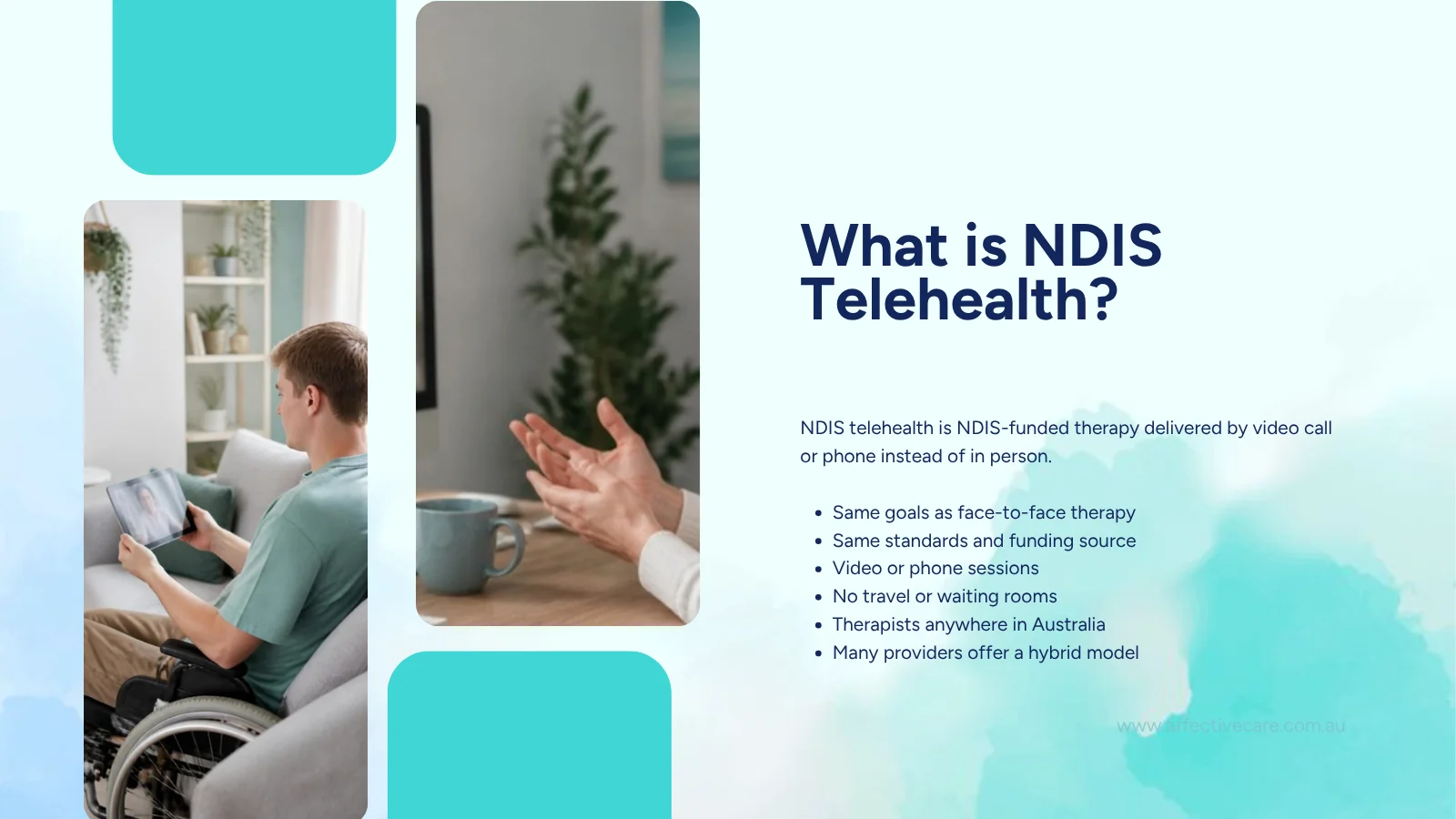
NDIS telehealth is any NDIS-funded therapy or specialist support that happens over a video call or phone call.
You and your therapist are in different places, but the session has the same goals, the same standards and the same funding source as an in-person appointment.
Most NDIS telehealth sessions use a secure video platform, such as Zoom, Microsoft Teams or a practice's own telehealth system.
Phone sessions are also used, especially for short check-ins or when video is hard for you. Some providers mix the two, for example an in-person assessment followed by NDIS telehealth sessions for ongoing therapy.
NDIS telehealth is not a separate type of funding. It is a way of delivering supports that are already in your plan. If your plan funds psychology, behaviour support or another therapy, you can usually choose to have some or all of it by telehealth.
Why NDIS telehealth has grown
NDIS telehealth became common during the COVID-19 pandemic and has stayed popular since. Many participants find it easier to fit into their week.
It removes travel, waiting rooms and the sensory load of a busy clinic. It also gives people in regional and remote areas access to therapists their town does not have.
What changed for NDIS telehealth in 2026–27?
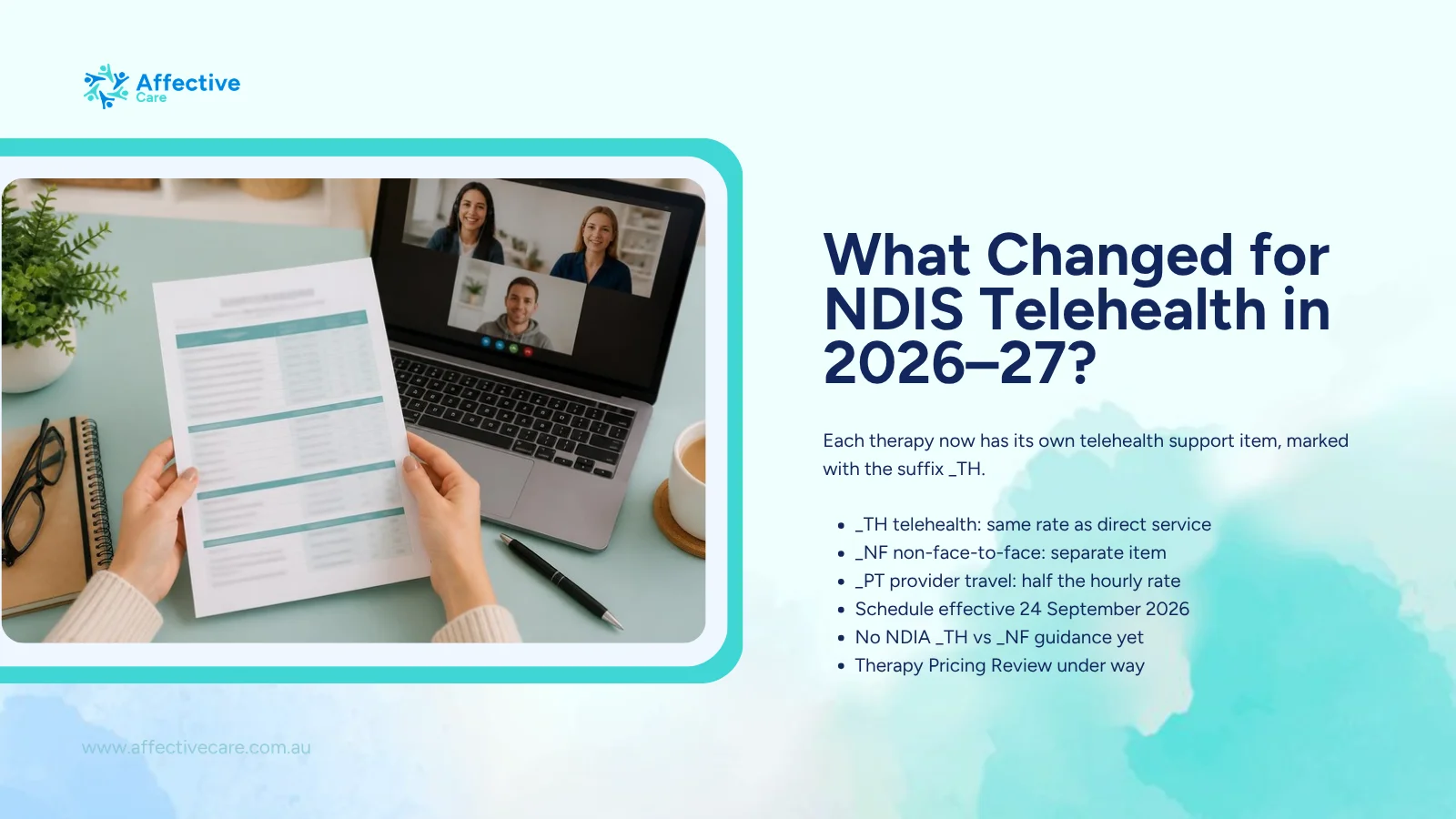
The biggest change is that NDIS telehealth now has its own support items. According to the NDIS Pricing Schedule 2026–27 (effective 24 September 2026), each therapy discipline has separate line items for direct service, telehealth, non-face-to-face work, provider travel, cancellations and NDIA-requested reports.
Before this, telehealth sessions were usually claimed under the same item as a face-to-face session. Now NDIS telehealth sessions are claimed under an item ending in _TH.
The NDIS says telehealth is charged at the same rate as a direct service, so a telehealth hour costs your plan the same as an in-person hour.
| Suffix | What it is for | Price |
|---|---|---|
| (none) | Direct, face-to-face service | Full hourly price limit |
| _TH | Telehealth session by video or phone | Same as direct service |
| _NF | Non-face-to-face work, such as planning and writing notes | Same as direct service |
| _PT | Provider travel to you | Half the hourly price limit |
| Cancellation item | Short notice cancellation | Set by the schedule and your agreement |
| NDIA requested reports | Reports the NDIA asks for | Same as direct service |
Two points are still open. The NDIA has not yet published detailed guidance on when providers should claim telehealth (_TH) instead of non-face-to-face (_NF).
The NDIA has also said its Therapy Pricing Review in 2026–27 may look at different prices for telehealth, but no change has been announced.
We will update these NDIS telehealth rules if anything changes. You can follow the bigger picture in our guide to NDIS changes in 2026.
Which therapies can you get through NDIS telehealth?
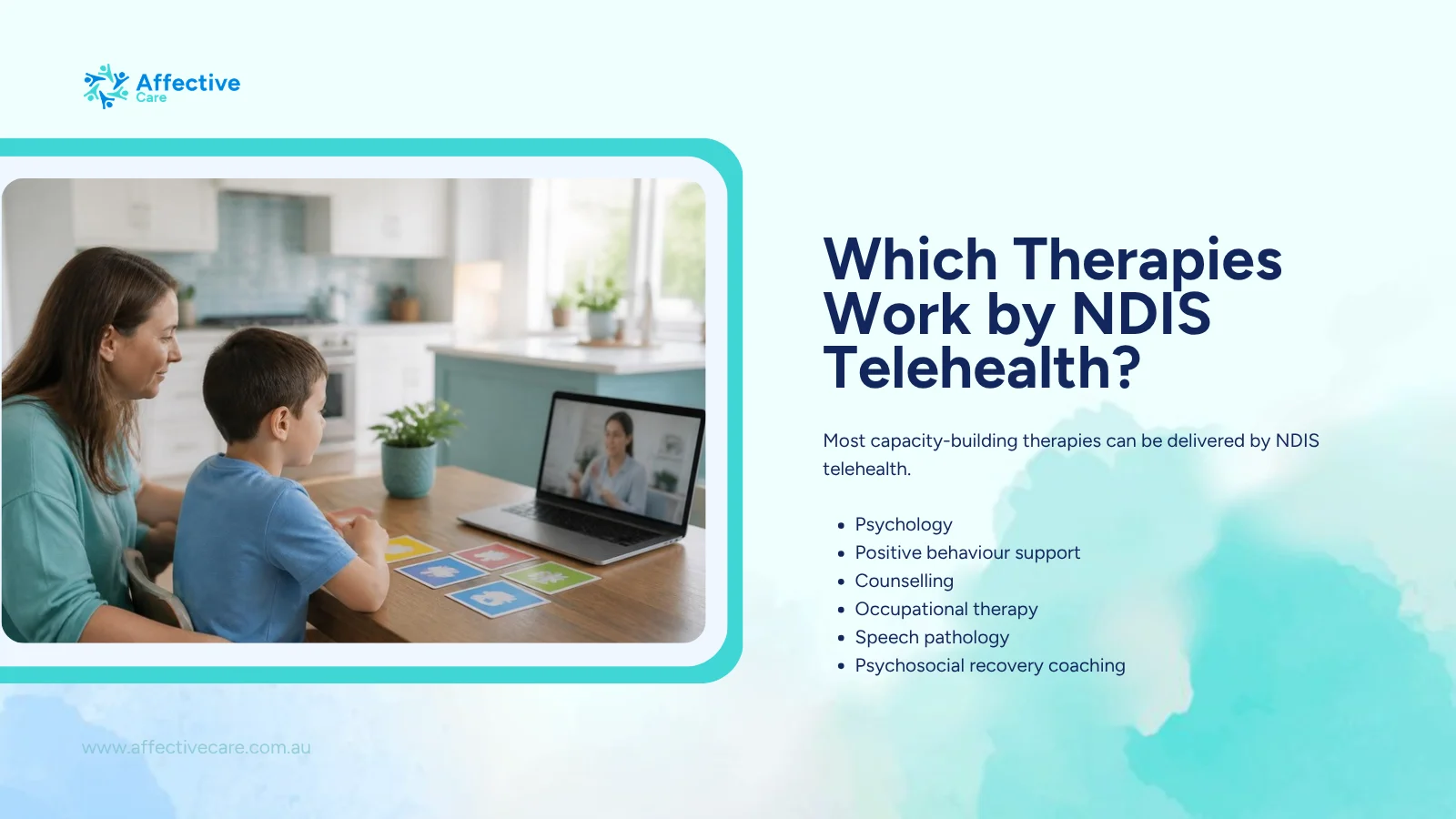
Most capacity-building therapies can be delivered by NDIS telehealth.
The best fit depends on the therapy, your goals and how you communicate. Talk-based and coaching-based supports usually work very well online.
- Psychology: assessments, therapy for anxiety, depression, trauma and emotional regulation, and support for autistic people and people with ADHD or psychosocial disability.
- Positive behaviour support (PBS): functional behaviour assessments, behaviour support plans, and coaching for families, carers and support workers.
- Counselling: talking therapy for stress, grief, relationships and adjusting to disability.
- Occupational therapy: daily living skills, sensory strategies, home and routine planning, and some assessments.
- Speech pathology: language, social communication, stuttering and parent coaching. Some swallowing assessments still need to be in person.
- Psychosocial recovery coaching: goal setting, building routines and linking with services. See our psychosocial recovery coaching service.
Some supports are harder to deliver by NDIS telehealth. Hands-on physiotherapy, equipment fitting and some assessments may still need a face-to-face visit.
Many providers use a hybrid model, where you see the therapist in person when you need to and use telehealth the rest of the time.
How does NDIS telehealth psychology work?
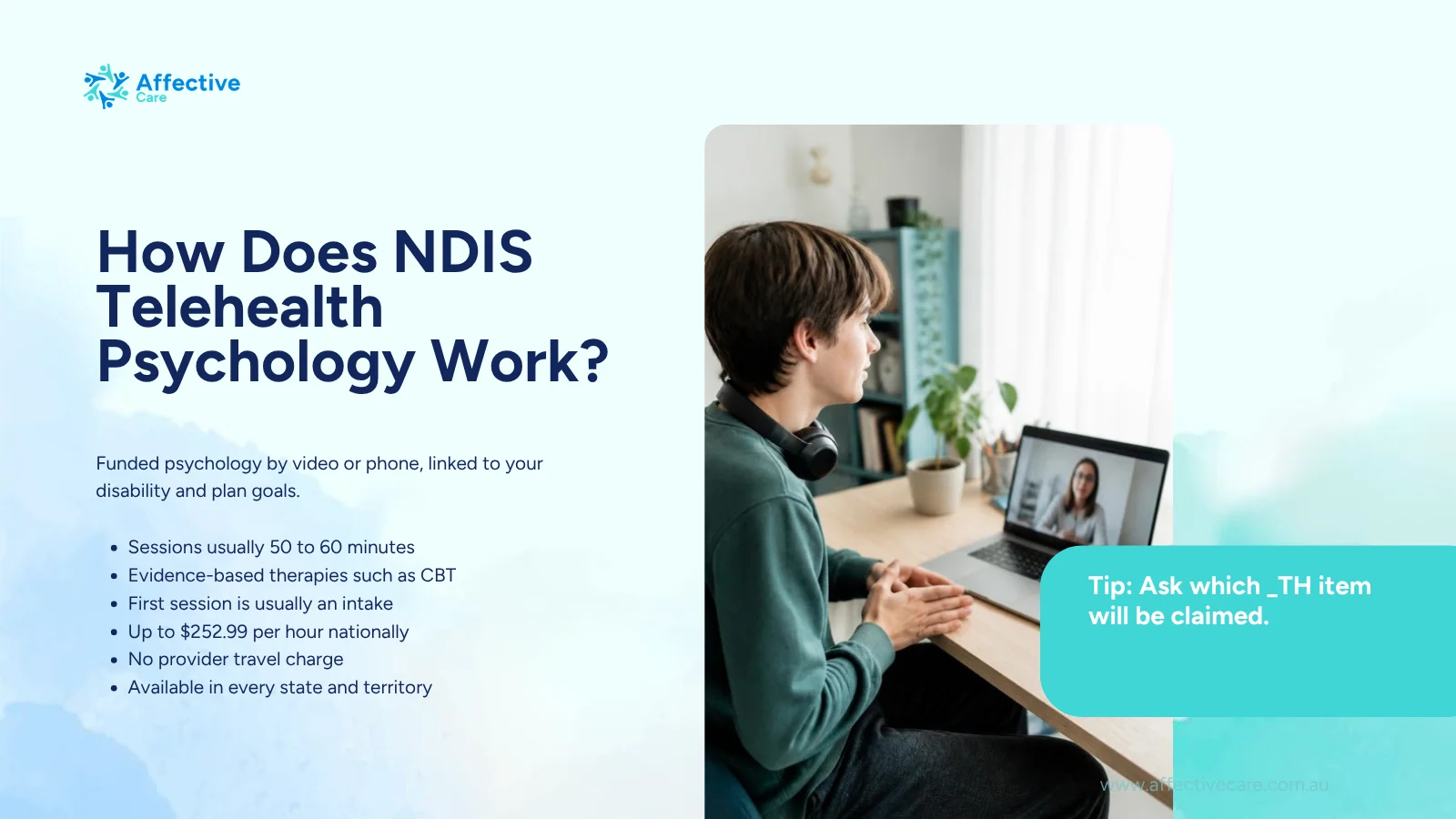
NDIS telehealth psychology is psychology funded by your NDIS plan and delivered by video or phone. Sessions usually run for 50 to 60 minutes.
Your psychologist uses the same evidence-based approaches as in a clinic, such as cognitive behaviour therapy, acceptance and commitment therapy or skills training.
NDIS telehealth psychology must be linked to your disability and your plan goals. The NDIS usually funds psychology that builds your capacity for daily life, relationships, work or community participation.
It does not usually fund mental health treatment that Medicare or the health system is responsible for. Our article does the NDIS cover telehealth psychology? explains this line in detail.
What to expect in your first session
Your first NDIS telehealth psychology session is usually an intake. The psychologist asks about your goals, your support needs and what has or has not helped before.
You will agree on a plan, how often to meet and how progress will be measured. For a step-by-step guide, read how telehealth psychology works.
If you are looking for a telehealth psychologist in Australia, Affective Care offers telehealth psychology for NDIS participants in every state and territory. You can also see our psychology services for in-person options.
How does telehealth positive behaviour support work?
Telehealth positive behaviour support is PBS delivered by video or phone.
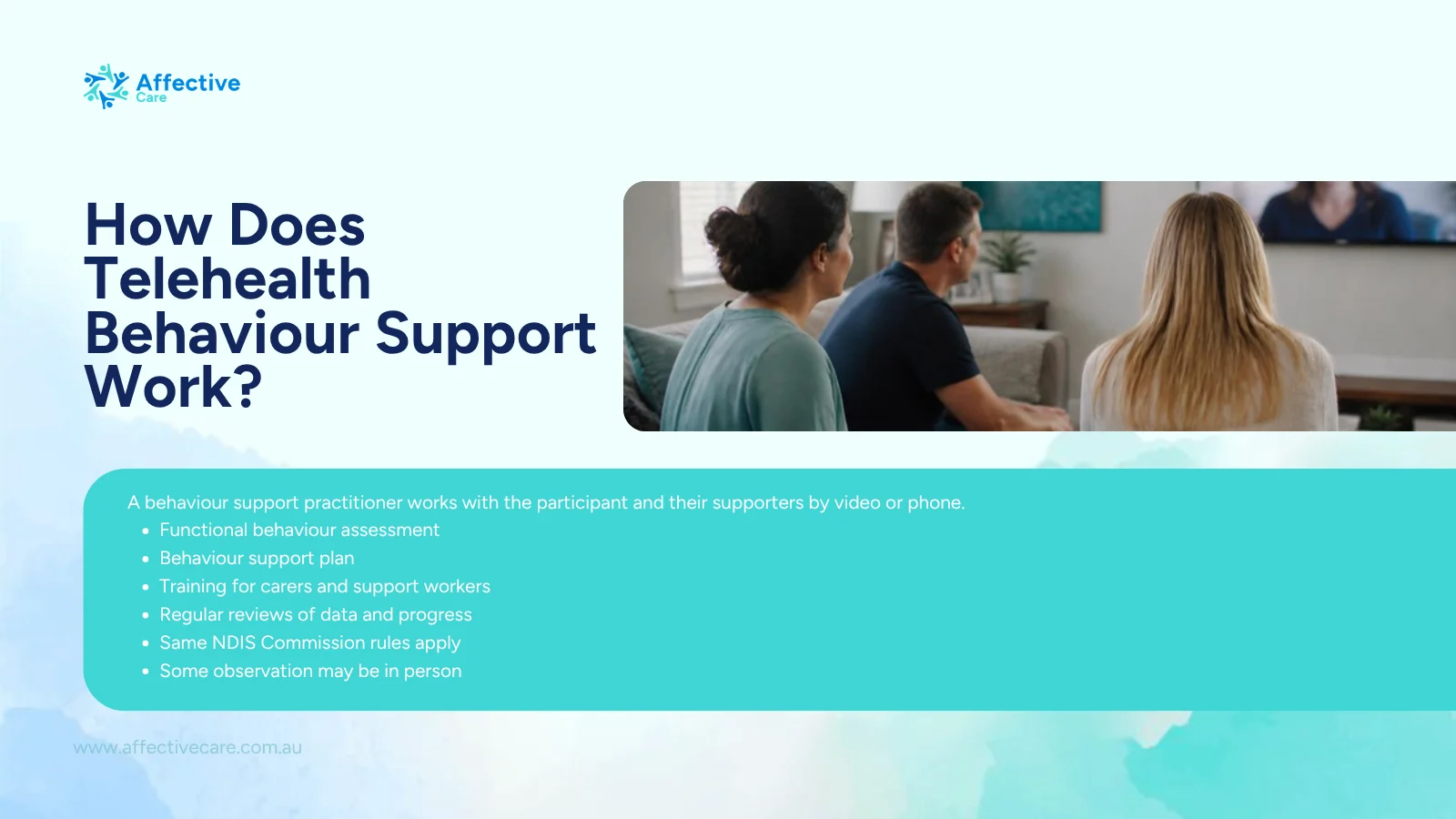
A behaviour support practitioner works with the participant and the people around them to understand why behaviours of concern happen and to build a plan that improves quality of life.
Telehealth positive behaviour support suits a lot of PBS work, because much of it involves talking with families, carers, teachers and support workers. NDIS telehealth makes it easier to bring everyone together, even when they are in different places.
- Functional behaviour assessment: the practitioner gathers information through interviews, questionnaires, data sheets and, where useful, short videos recorded at home.
- Behaviour support plan: the practitioner writes a plan with proactive strategies, skill-building goals and safe responses.
- Training and coaching: carers and support workers learn the plan in live video sessions.
- Review: the practitioner checks data, adjusts strategies and reports progress.
A telehealth behaviour support plan follows the same rules as any other plan, including NDIS Quality and Safeguards Commission requirements for regulated restrictive practices.
Some observation may still happen in person. Learn more about our telehealth PBS service, our wider positive behaviour support service, or how PBS differs for children and adults.
What is NDIS telehealth counselling?
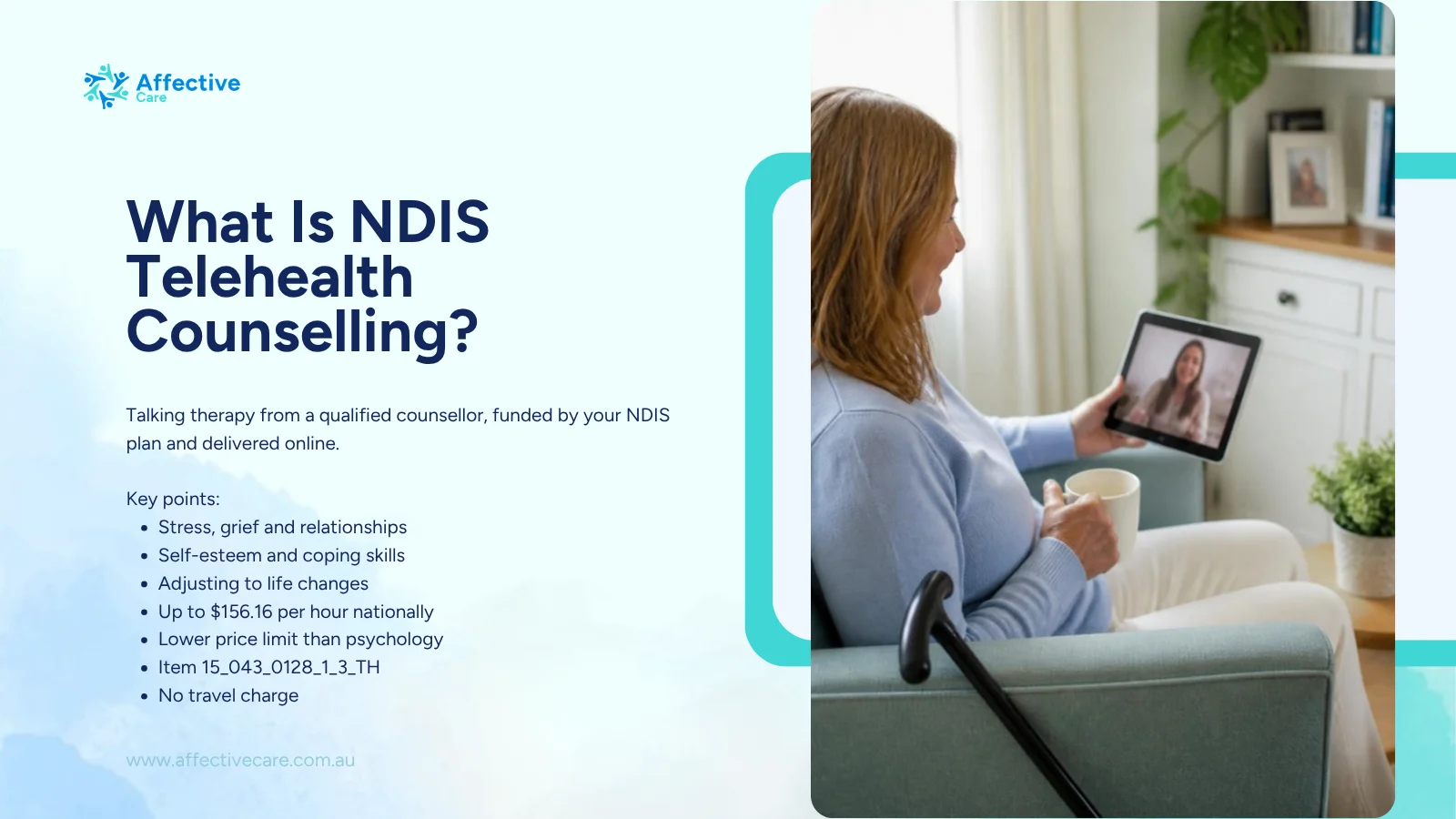
NDIS telehealth counselling is talking therapy from a qualified counsellor, funded by your NDIS plan and delivered online or by phone. It can help with stress, grief, relationships, self-esteem and adjusting to life changes linked to your disability.
NDIS telehealth counselling has a lower price limit than psychology, which can make your therapy budget go further.
Counselling may suit you if you want support to talk things through and build coping skills, rather than a psychological assessment or a structured clinical treatment.
Read our guide to counselling vs psychology to compare them, or see our telehealth counselling service.
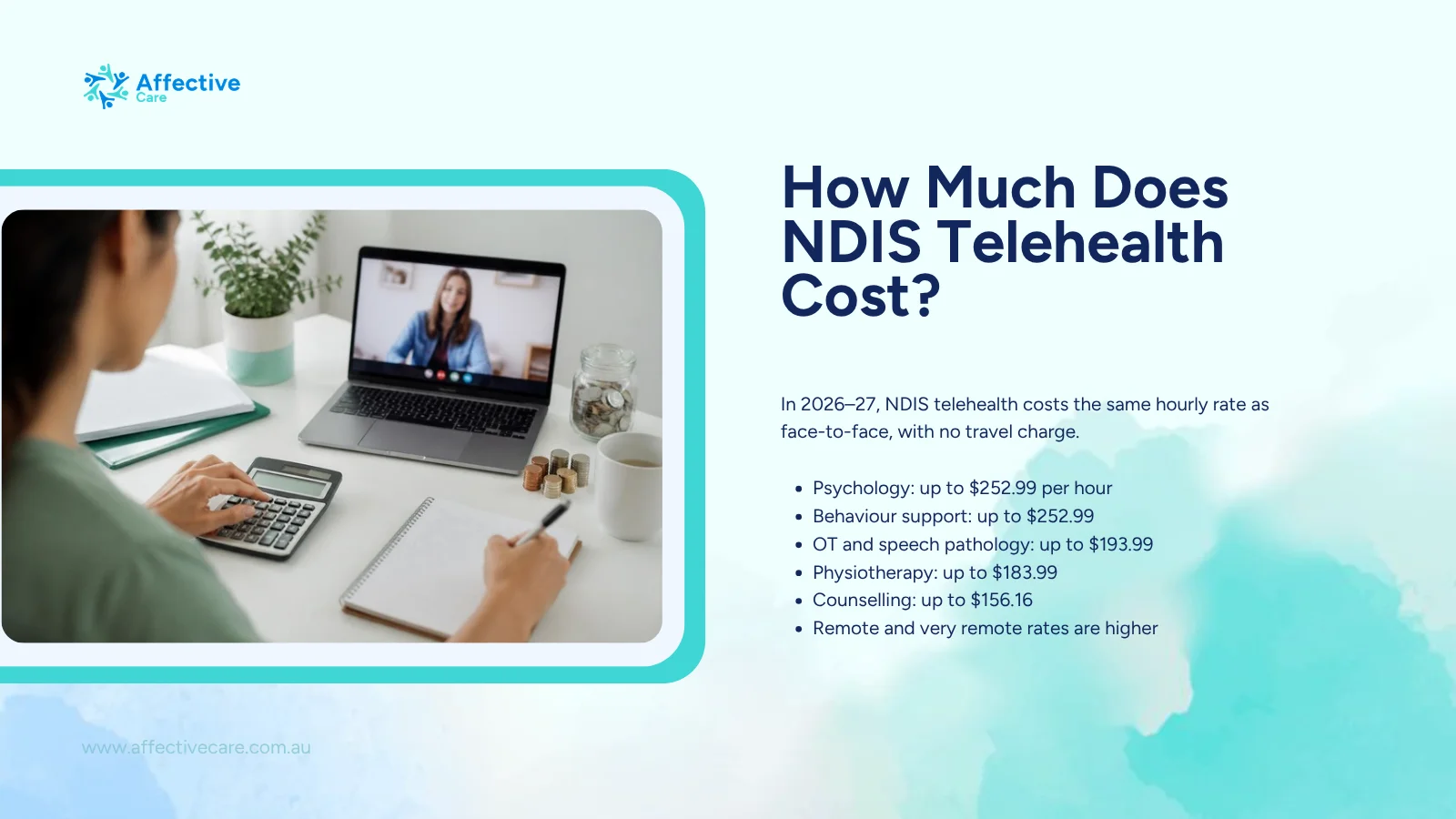
How much does NDIS telehealth cost in 2026–27?
NDIS telehealth costs the same as a face-to-face session. Under the NDIS telehealth price guide figures in the Pricing Schedule 2026–27, the telehealth item for each therapy has the same price limit as the direct service item. Psychology is up to $252.99 per hour nationally.
| Therapy | National | Remote | Very remote |
|---|---|---|---|
| Psychology | $252.99 | $354.19 | $379.49 |
| Specialist behaviour support (11_022_0110_7_3_TH) | $252.99 | $354.19 | $379.49 |
| Occupational therapy | $193.99 | $271.59 | $290.99 |
| Speech pathology | $193.99 | $271.59 | $290.99 |
| Physiotherapy | $183.99 | $257.59 | $275.99 |
| Dietetics | $178.99 | $250.59 | $268.49 |
| Counselling (15_043_0128_1_3_TH) | $156.16 | $218.62 | $234.24 |
Psychology is the main therapy to rise in 2026–27. The national price limit went up by $20 an hour, from $232.99 in 2025–26 to $252.99.
That rise applies to direct, telehealth, non-face-to-face and report items. Other therapy rates were held or reduced. For every support item, see our NDIS price guide and our explainer on NDIS pricing arrangements.
Why NDIS telehealth can still save money
The hourly rate is the same, but NDIS telehealth removes provider travel. Under the 2026–27 schedule, therapy travel is claimed under a separate item at half the hourly rate.
For psychology that is up to $126.50 an hour of travel. With telehealth there is no travel to claim, so more of your budget pays for therapy time.
| Cost item | Face-to-face at home | NDIS telehealth |
|---|---|---|
| Session (1 hour) | $252.99 | $252.99 |
| Provider travel (30 minutes at $126.50 per hour) | $63.25 | $0.00 |
| Total charged to your plan | $316.24 | $252.99 |
| Over 20 sessions | $6,324.80 | $5,059.80 |
These examples use maximum price limits. Your provider may charge less, and travel is only charged when your service agreement allows it.
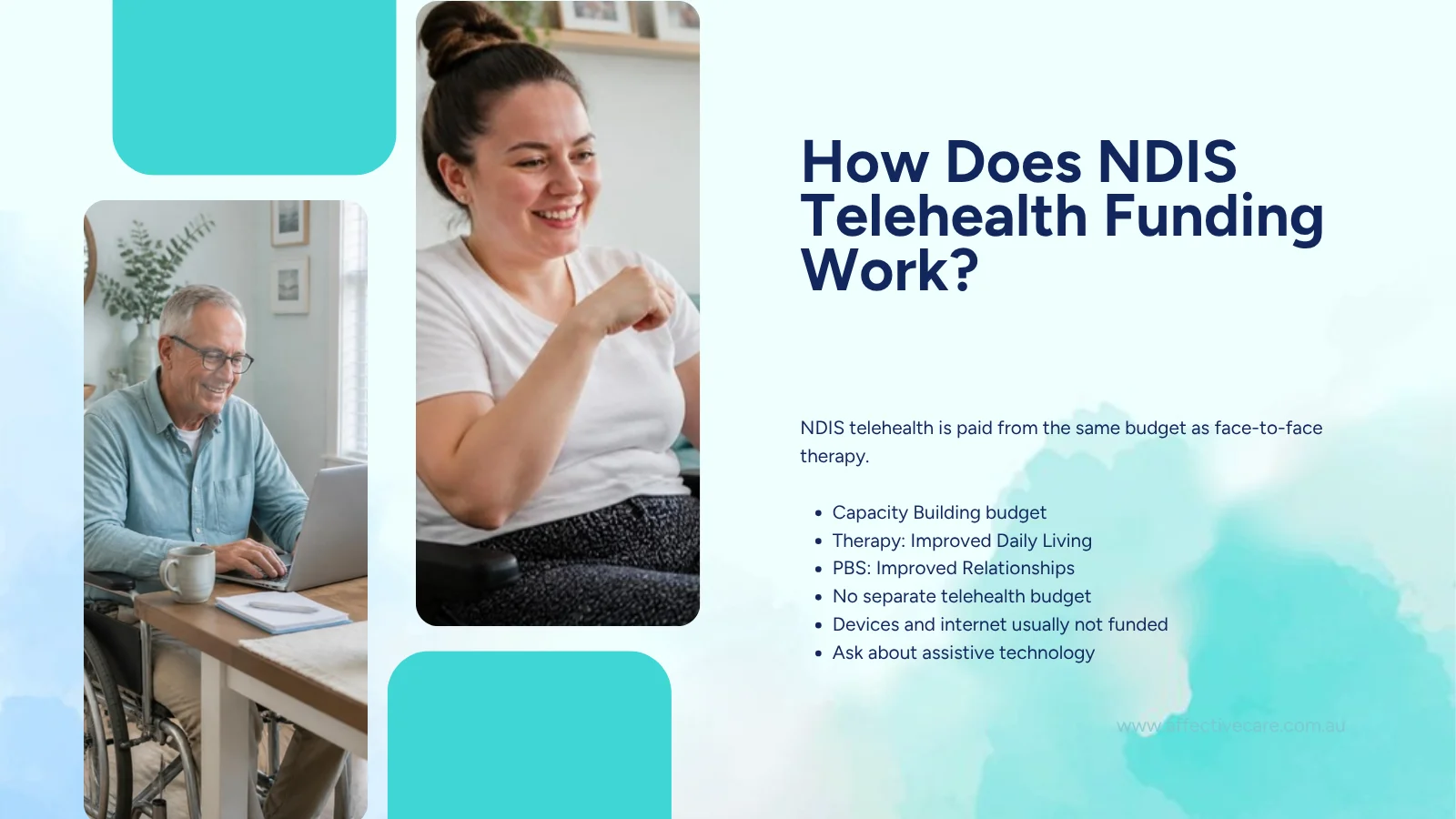
How does NDIS telehealth funding work?
NDIS telehealth funding comes from the same budget as face-to-face therapy. Most therapy is paid from your Capacity Building budget, usually Improved Daily Living (CB Daily Activity).
Behaviour support is usually funded under Improved Relationships. There is no separate NDIS telehealth budget to ask for.
| NDIS telehealth support | Usual budget | Category |
|---|---|---|
| Psychology | Capacity Building | Improved Daily Living |
| Occupational therapy and speech pathology | Capacity Building | Improved Daily Living |
| Counselling | Capacity Building | Improved Daily Living |
| Positive behaviour support | Capacity Building | Improved Relationships |
| Psychosocial recovery coaching | Capacity Building | Improved Daily Living |
Our guide to NDIS Improved Daily Living explains what this budget covers and how to check how much you have left.
Does the NDIS pay for devices or internet for telehealth?
Usually not. The NDIS treats phones, computers, data and internet as everyday living costs, so NDIS telehealth funding does not normally cover them.
If your disability means you need specialised technology to communicate, talk to your support coordinator about assistive technology.
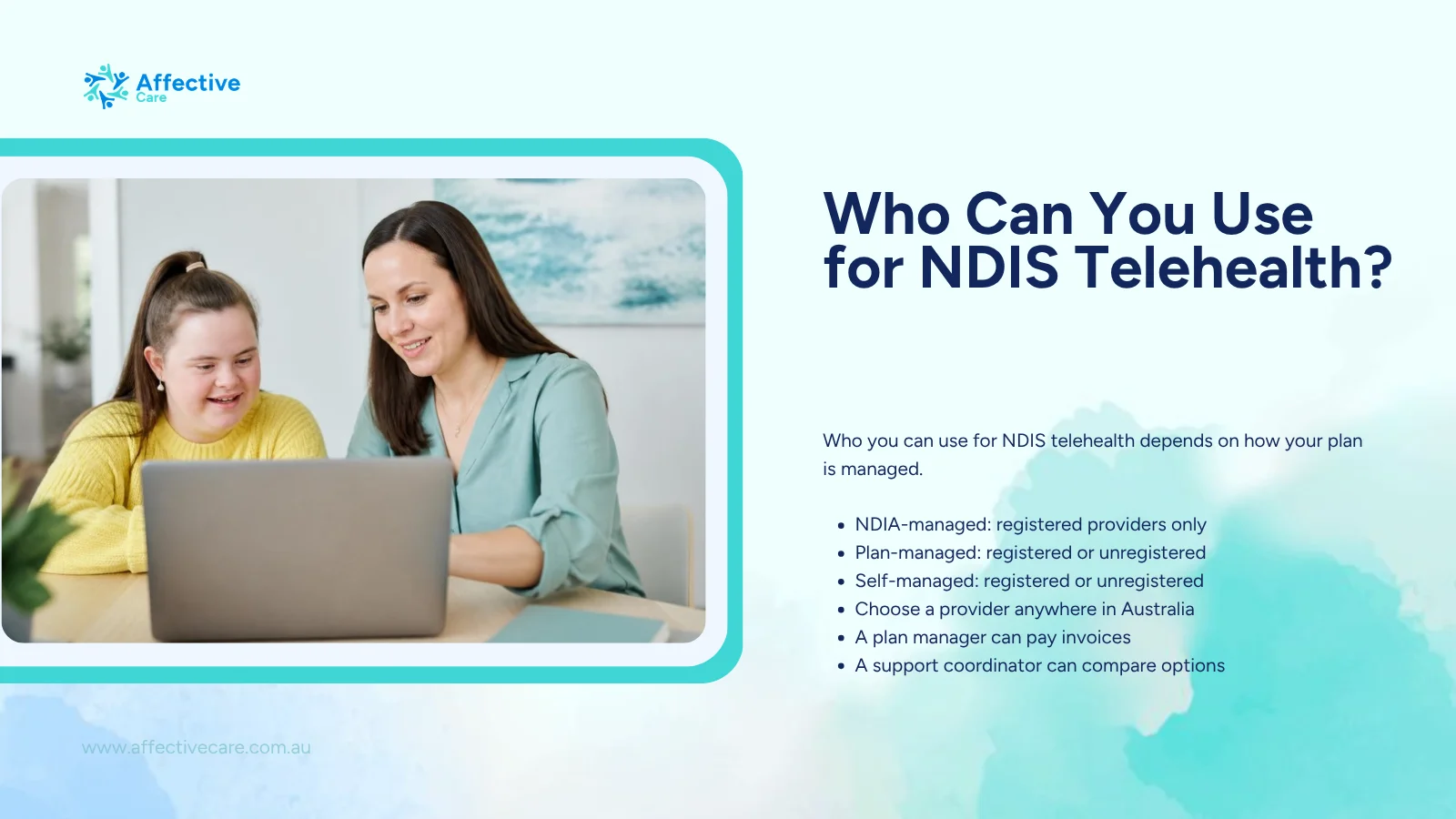
Who can you use for NDIS telehealth with your plan type?
The NDIS telehealth rules about who you can use depend on how your plan is managed. NDIA-managed participants must use registered NDIS providers.
Plan-managed and self-managed participants can use registered or unregistered providers.
| Plan type | Who can provide NDIS telehealth? | Do price limits apply? |
|---|---|---|
| NDIA-managed | Registered NDIS providers only | Yes |
| Plan-managed | Registered or unregistered providers | Yes |
| Self-managed | Registered or unregistered providers | No, but funds must be used in line with your plan |
Because NDIS telehealth is not limited by distance, you can choose a provider in another city or state. This gives you more choice, especially if you want a therapist with specific experience, a particular language or a similar cultural background.
A plan manager can pay invoices from any provider, and a support coordinator can help you compare options.
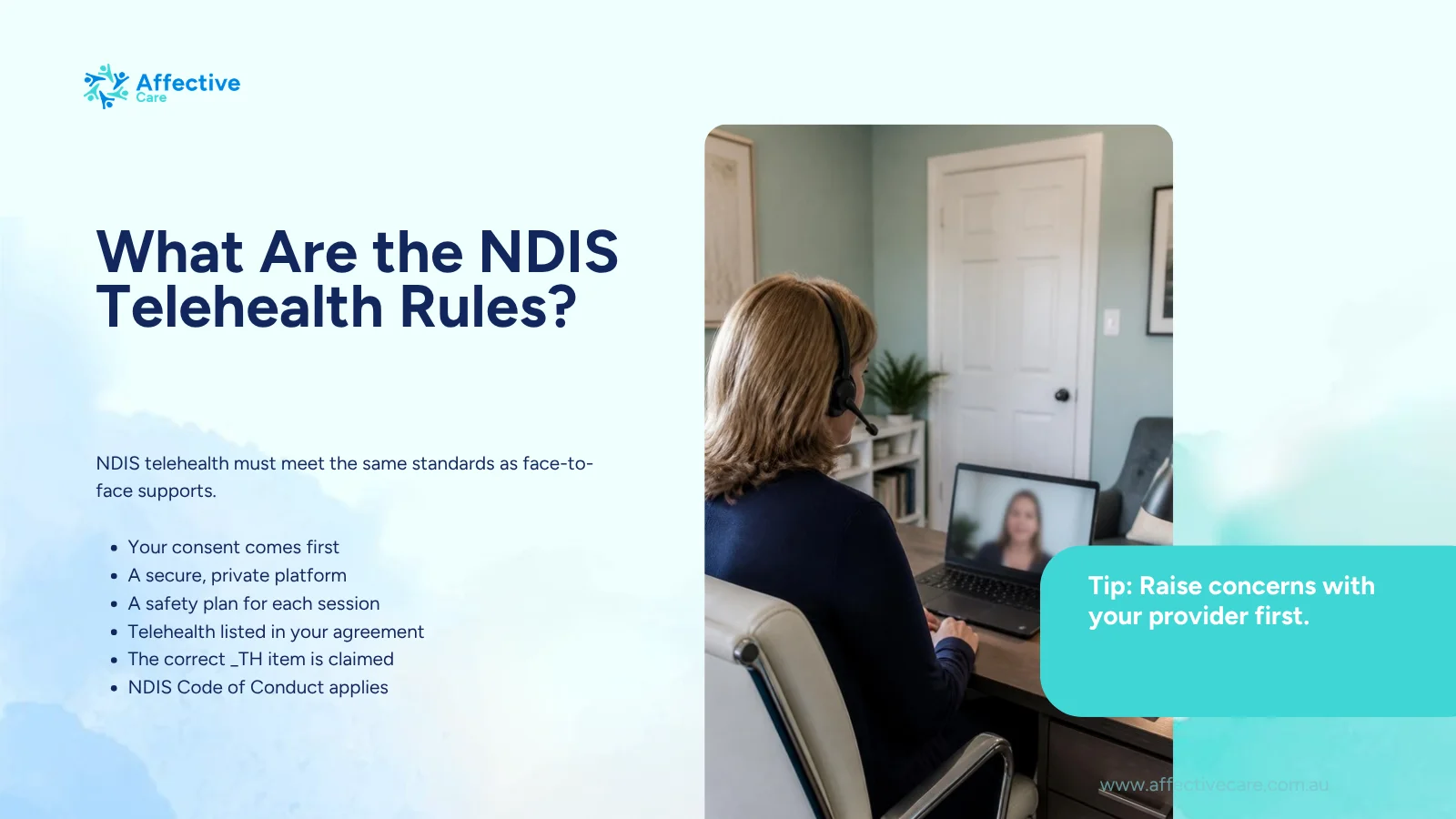
What are the NDIS telehealth rules for providers?
NDIS telehealth sessions must meet the same standards as face-to-face supports.
Providers must follow the NDIS Code of Conduct, protect your privacy and keep clear records. Registered providers must also meet the NDIS Practice Standards.
- Consent: your provider should explain how NDIS telehealth works and get your consent before starting.
- Privacy: sessions should use a secure platform, and the therapist should be in a private space.
- Safety plan: your provider should know where you are during each session and what to do if you become unwell or unsafe.
- Service agreement: your agreement should say which services are by telehealth, the price and the cancellation terms.
- Correct claiming: telehealth sessions should be claimed under the right _TH item, not as travel or face-to-face time.
If something does not feel right, raise it with your provider first. You can also contact the NDIS Quality and Safeguards Commission.
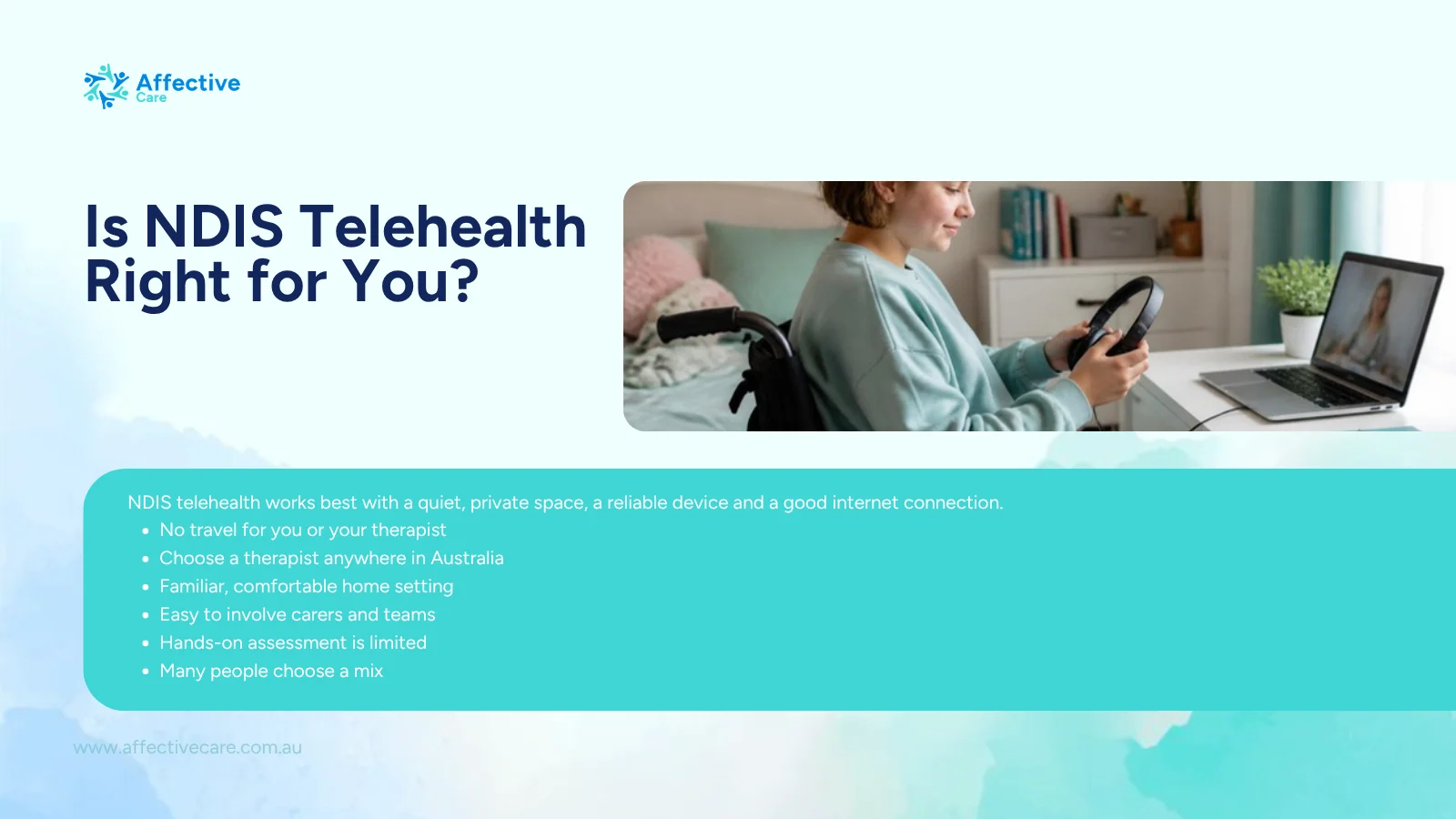
Is NDIS telehealth right for you?
NDIS telehealth suits many people, but not everyone. It works best when you have a quiet, private space, a reliable device and internet connection, and a way of communicating that works on a screen or phone.
| Factor | NDIS telehealth | Face-to-face |
|---|---|---|
| Travel | None for you or your therapist | Travel time and possible travel charges |
| Choice of therapist | Anyone in Australia | Limited to your local area |
| Comfort | Familiar home setting | Clinic or home visit |
| Hands-on assessment | Limited | Full |
| Involving carers and teams | Easy to join from anywhere | Everyone must be in one place |
| Technology needed | Device, internet and private space | None |
NDIS telehealth may be less suitable if you find screens distressing, if you need hands-on support, or if there is no private space at home. Many people choose a mix. Read our full comparison of telehealth vs face-to-face psychology to help you decide.
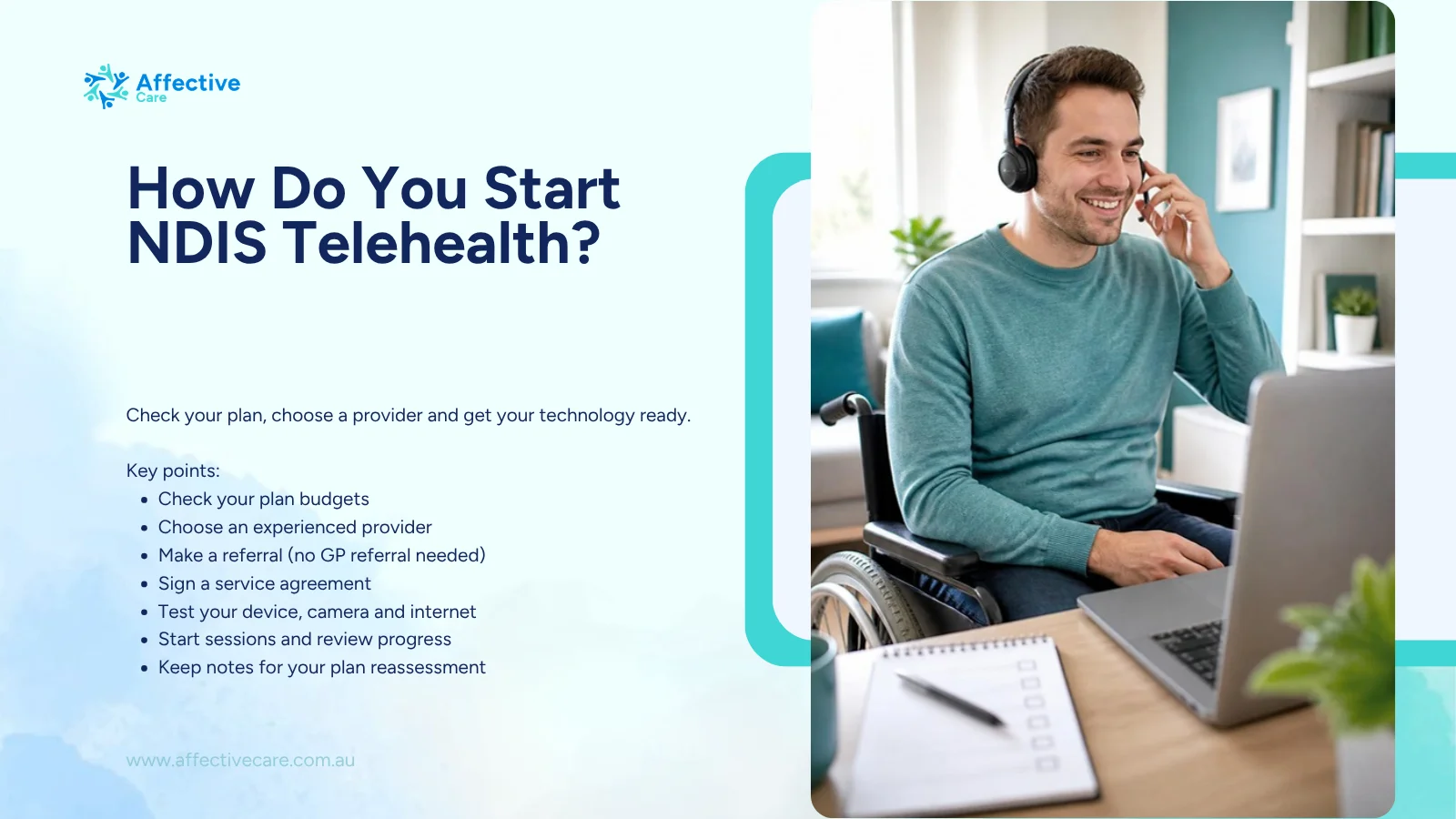
How do you get started with NDIS telehealth?
Getting started with NDIS telehealth takes a few simple steps. Check your plan, choose a provider and make sure your technology is ready before your first session.
- Check your plan. Look for funding in Improved Daily Living or Improved Relationships, and check how your plan is managed.
- Choose a provider. Look for a therapist with the right experience and NDIS telehealth expertise. Our guide to the best telehealth providers in Australia can help.
- Make a referral. You, your family, your support coordinator or your GP can contact the provider. A GP referral is not required for NDIS telehealth psychology.
- Sign a service agreement. Check the support items, price, cancellation terms and which sessions are by telehealth.
- Get ready. Test your device, camera, microphone and internet. Use our telehealth ready checklist before your first session.
- Start and review. Attend your sessions, track progress against your goals, and keep notes for your next plan reassessment.
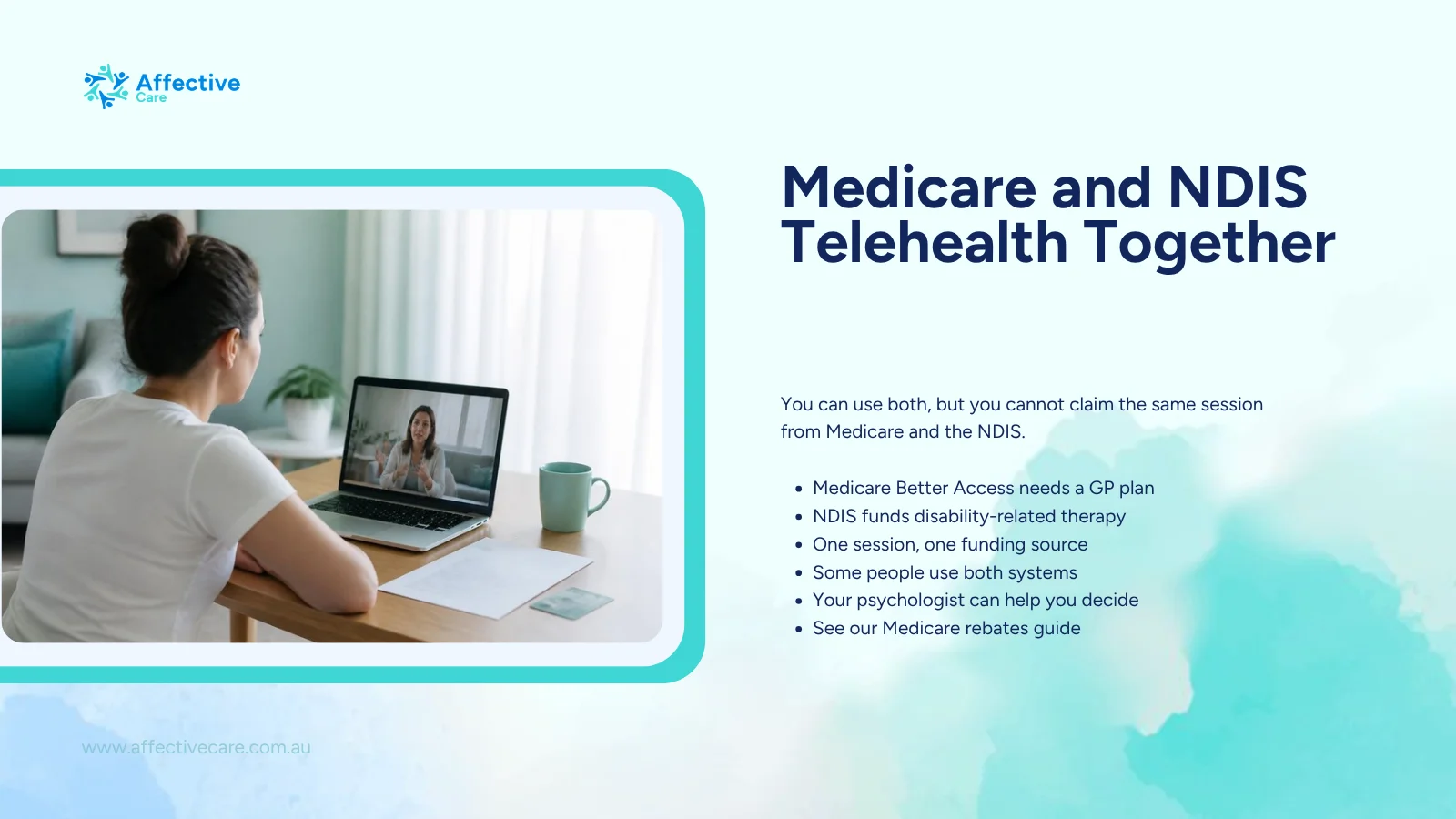
Can you use Medicare and NDIS telehealth together?
Yes, but not for the same session. Medicare's Better Access program can pay rebates for mental health sessions with a GP mental health treatment plan, including by telehealth.
NDIS telehealth psychology pays for psychology linked to your disability and your plan goals. One session cannot be claimed from both.
Some people use Medicare for mental health treatment and the NDIS for disability-related capacity building.
Your psychologist can help you work out which system fits each part of your care. Read more in our guide to Medicare rebates for psychology, or browse other telehealth psychologists in Australia.
This article is general information only. Funding decisions are made by the NDIA, and prices can change during the year. Check the current NDIS Pricing Schedule and speak with your plan manager, local area coordinator or support coordinator about your plan.
Frequently asked questions
Does the NDIS fund telehealth?
Yes. The NDIS funds telehealth when the therapy itself is a reasonable and necessary support in your plan. NDIS telehealth is a way of delivering supports, not a separate funding type, so it is paid from the same Capacity Building budget as face-to-face therapy.
How much does NDIS telehealth psychology cost in 2026?
Under the NDIS Pricing Schedule 2026–27, NDIS telehealth psychology is up to $252.99 per hour nationally, $354.19 in remote areas and $379.49 in very remote areas. That is the same as a face-to-face session, but there is no provider travel charge.
What is the NDIS telehealth support item?
From 2026–27, each therapy has its own telehealth item ending in _TH. For example, specialist behavioural intervention support by telehealth is 11_022_0110_7_3_TH and counselling by telehealth is 15_043_0128_1_3_TH. Telehealth is charged at the direct service rate.
Can positive behaviour support be done by telehealth?
Yes. Telehealth positive behaviour support can include functional behaviour assessments, writing a behaviour support plan and training carers and support workers. Some observation may still happen in person. It is usually funded from Improved Relationships in your Capacity Building budget.
Do I need a GP referral for NDIS telehealth?
No. You do not need a GP referral to use NDIS telehealth psychology, counselling or behaviour support. You need funding in your plan and a service agreement with the provider. A GP mental health treatment plan is only needed for Medicare rebates.
Can I use an interstate provider for NDIS telehealth?
Yes. NDIS telehealth lets you see a provider anywhere in Australia. NDIA-managed participants must choose a registered NDIS provider. Plan-managed and self-managed participants can use registered or unregistered providers.
Does the NDIS pay for a laptop or internet for telehealth?
Usually not. Devices, data and internet are treated as everyday living costs. If you need specialised technology because of your disability, ask your support coordinator about assistive technology funding.